
Quick Answer
When an aging parent begins struggling with the bathroom, families often find themselves asking a much bigger question: Is the home still safe, or is it time to consider assisted living?
The answer depends less on the bathroom itself than on what kind of help the person actually needs.
The national median cost of assisted living is $6,200 per month, or $74,400 per year, according to the CareScout 2025 Cost of Care Survey. In Colorado, converting a tub to an accessible walk-in shower typically costs $14,000 to $24,000 as a one-time expense. That is roughly two to four months of assisted living.
If mobility and bathroom safety are the primary problems, remodeling can be significantly less expensive than moving to assisted living. But if the person needs supervision, medication management, overnight help, assistance with several activities of daily living, or memory care, a bathroom remodel does not solve the underlying problem.
That distinction is the most important thing to understand before comparing the costs.
This article covers four questions:
- What each option actually costs, with real numbers on both sides
- Who pays for what, including the Medicare answer most families get wrong
- How the two compare on quality of life, honestly, in both directions
- How to tell which one your situation actually calls for
Bathroom Remodel vs. Assisted Living: At a Glance
|
Accessibility Bathroom Remodel |
Assisted Living |
|
|
Best when |
Mobility, balance, strength, or bathroom access is the primary problem |
Ongoing care, supervision, medication management, or multiple daily activities require help |
|
Typical cost |
$14,000 to $30,000 for most accessibility-focused Colorado projects |
About $6,200 nationally or $6,584 per month in Colorado, before some additional care charges |
|
One-time or ongoing cost |
Primarily one-time |
Monthly and typically increases over time |
|
24/7 staff available |
No |
Yes |
|
Meals and housekeeping included |
No |
Typically yes |
|
Remain in current home |
Yes |
No |
|
Built-in social opportunities |
No |
Yes |
|
Best fit |
Stable needs, intact cognition, functional home and desire to remain there |
Escalating care needs, cognitive decline, caregiver limitations or need for regular supervision |
The simplest way to frame the decision: If the problem is primarily access, consider changing the home. If the problem is primarily care or supervision, changing the bathroom may not be enough.
What Each Option Actually Is
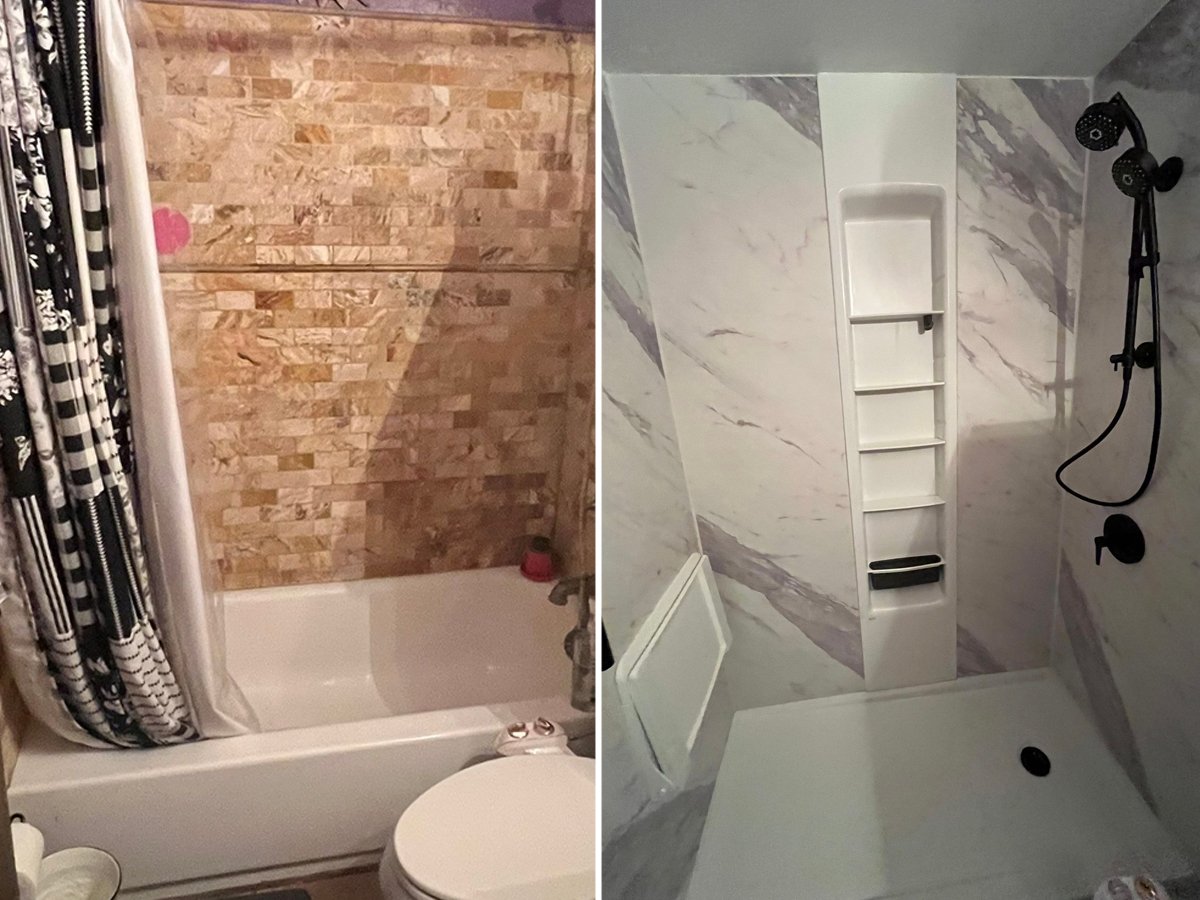
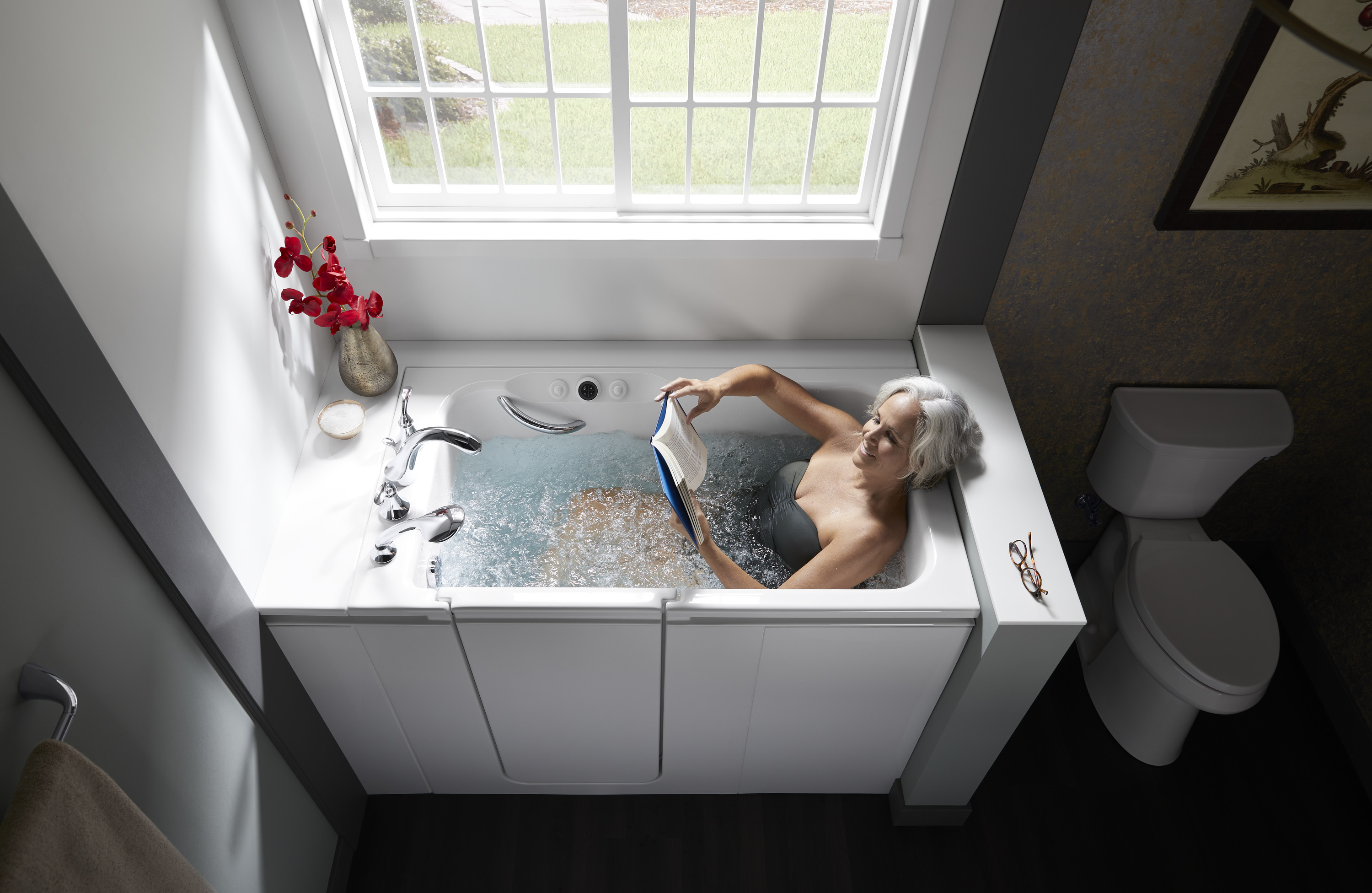
An aging in place bathroom remodel
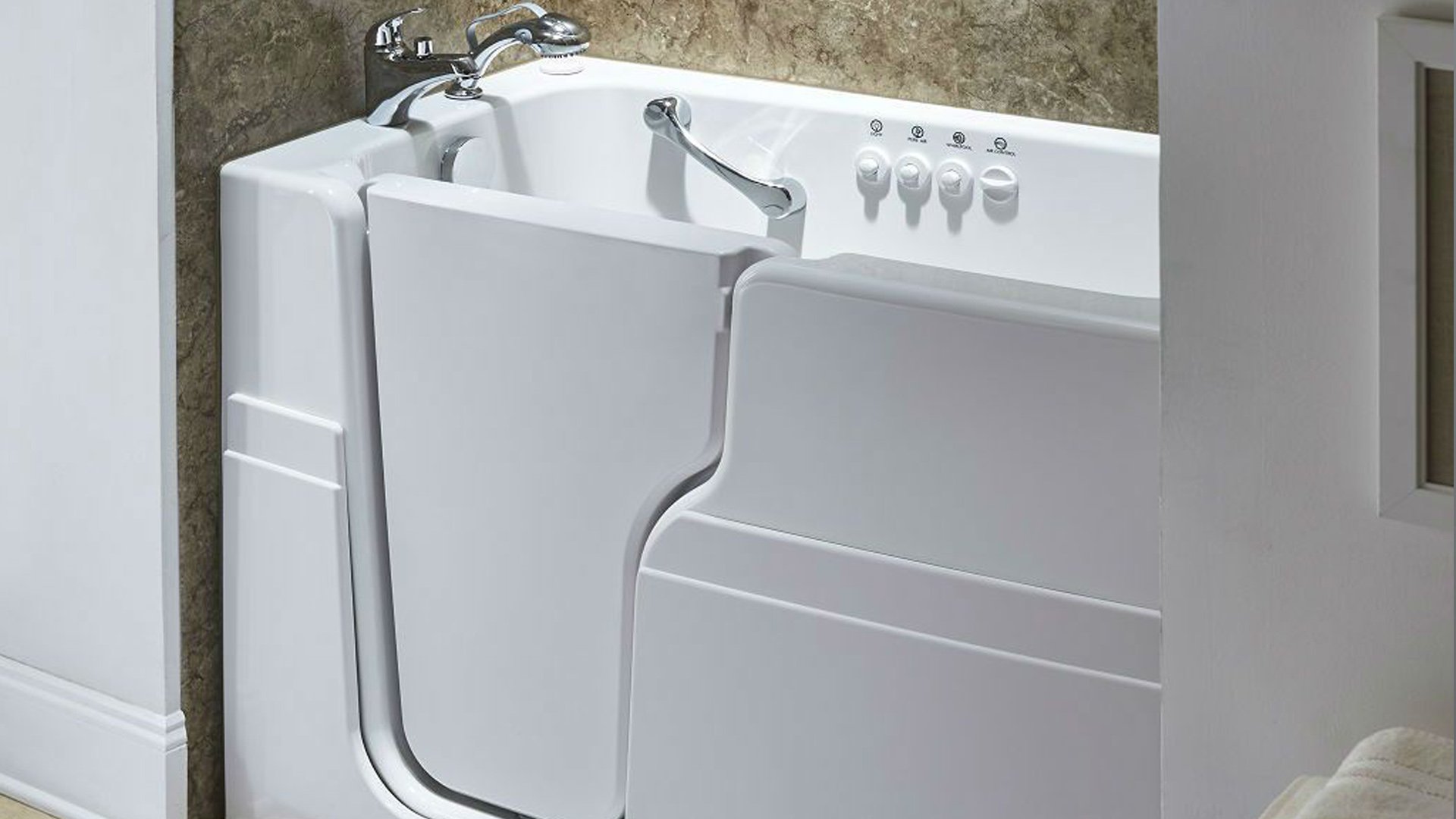
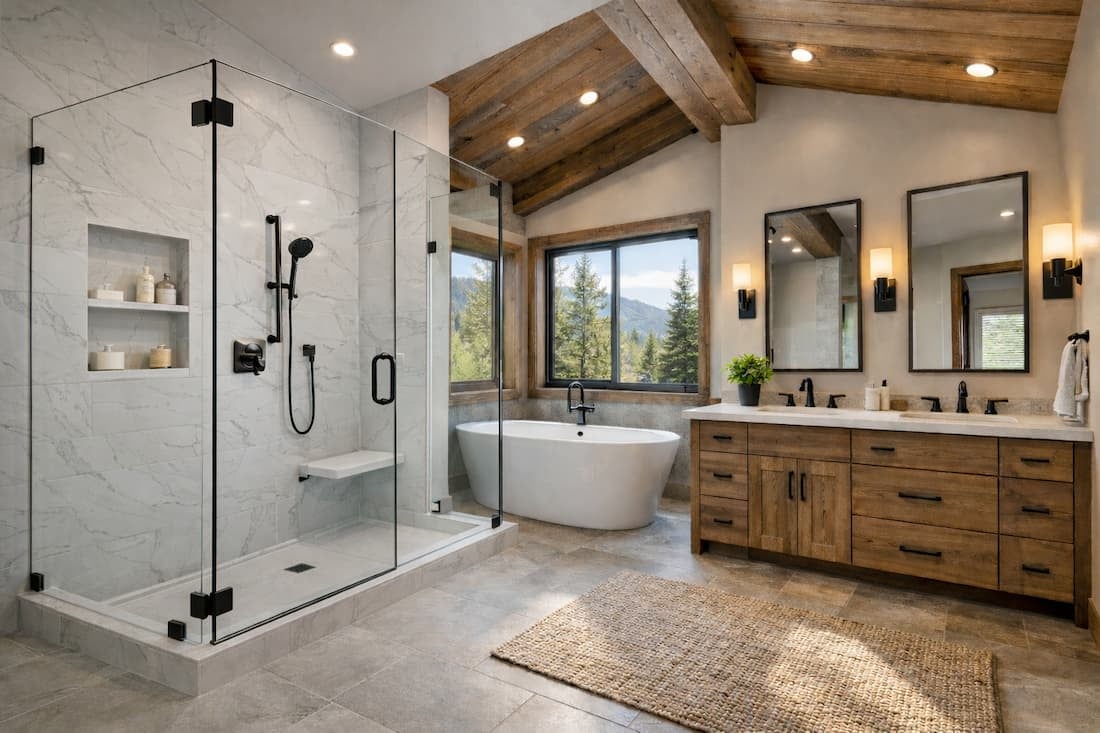
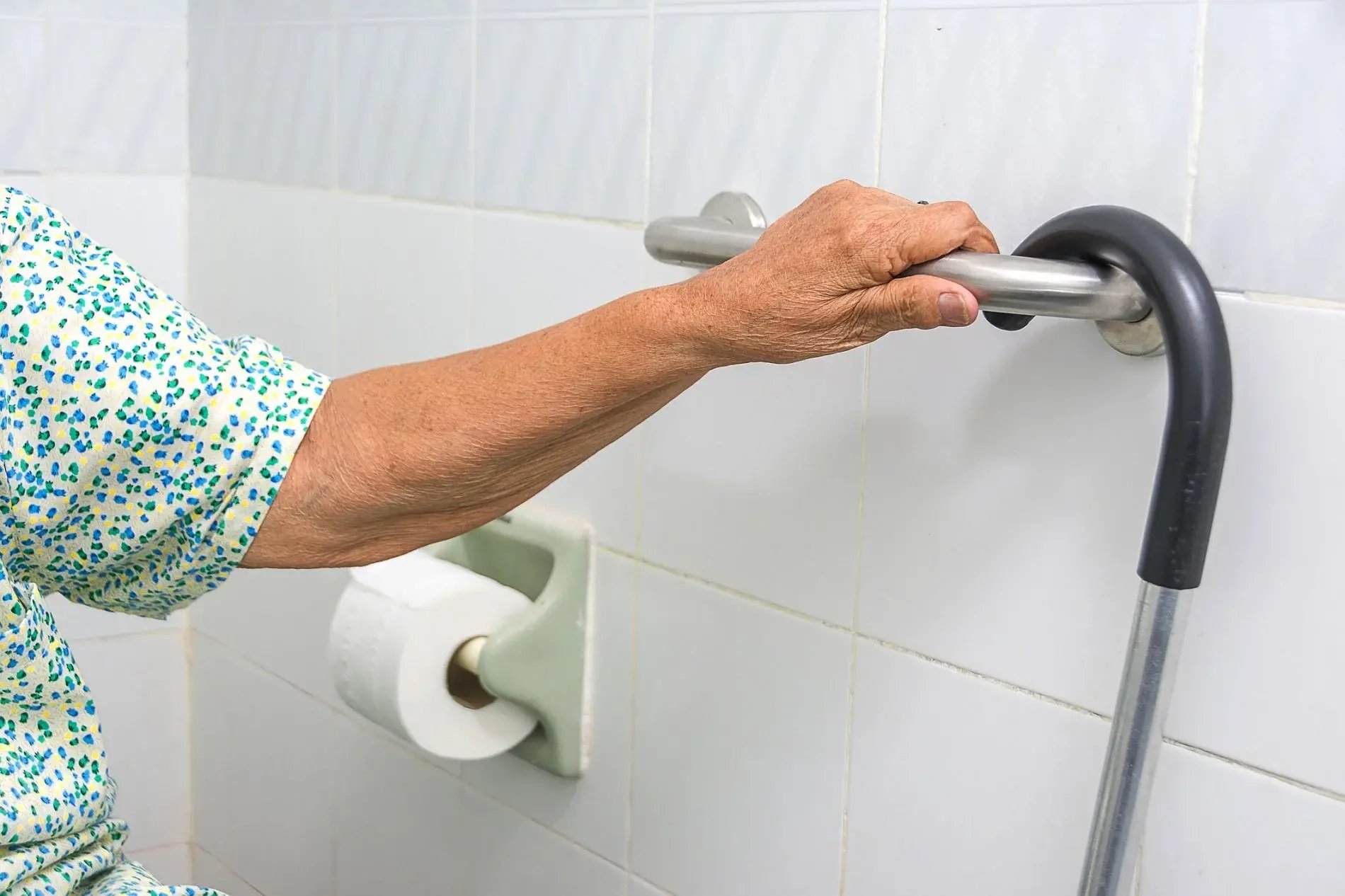
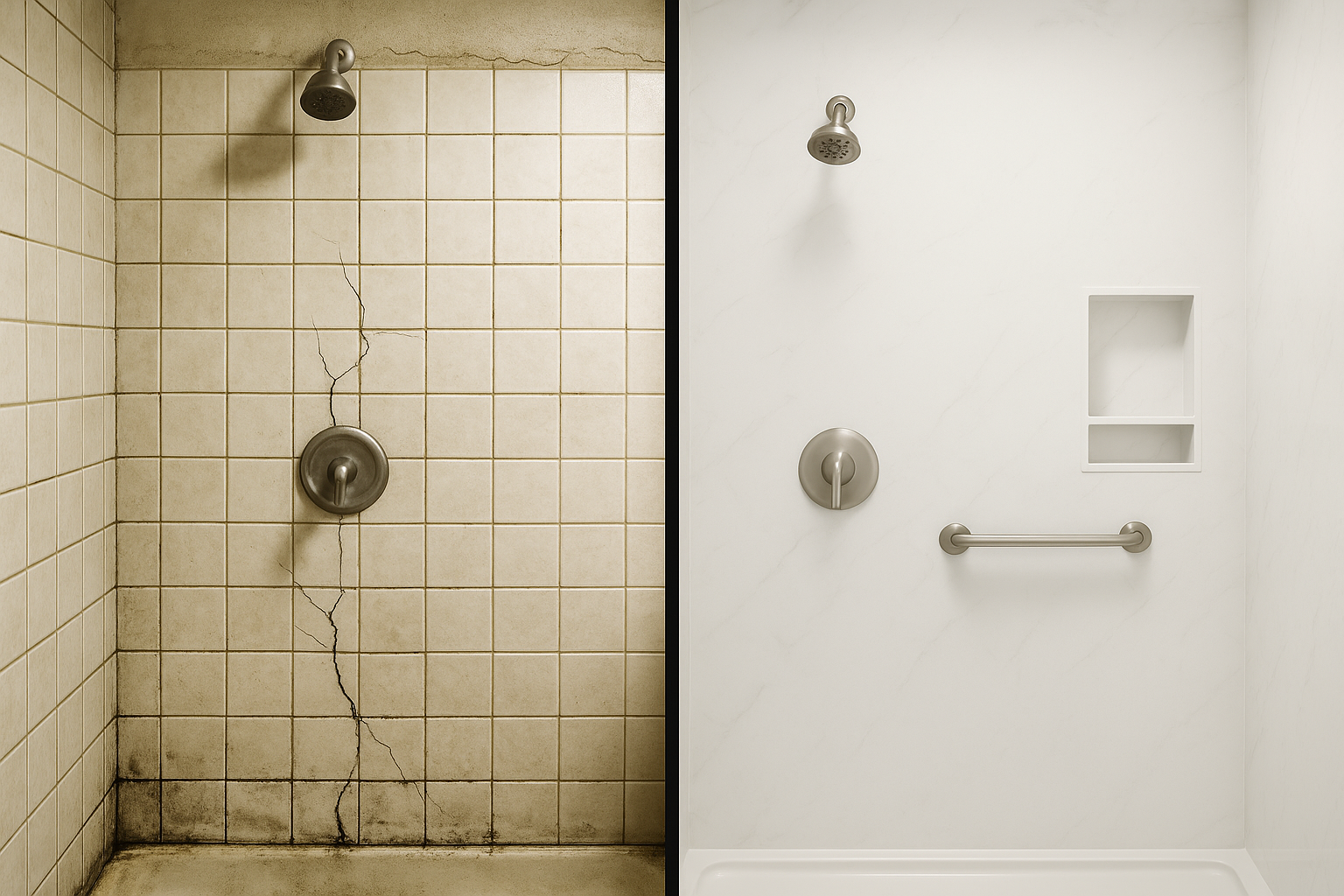
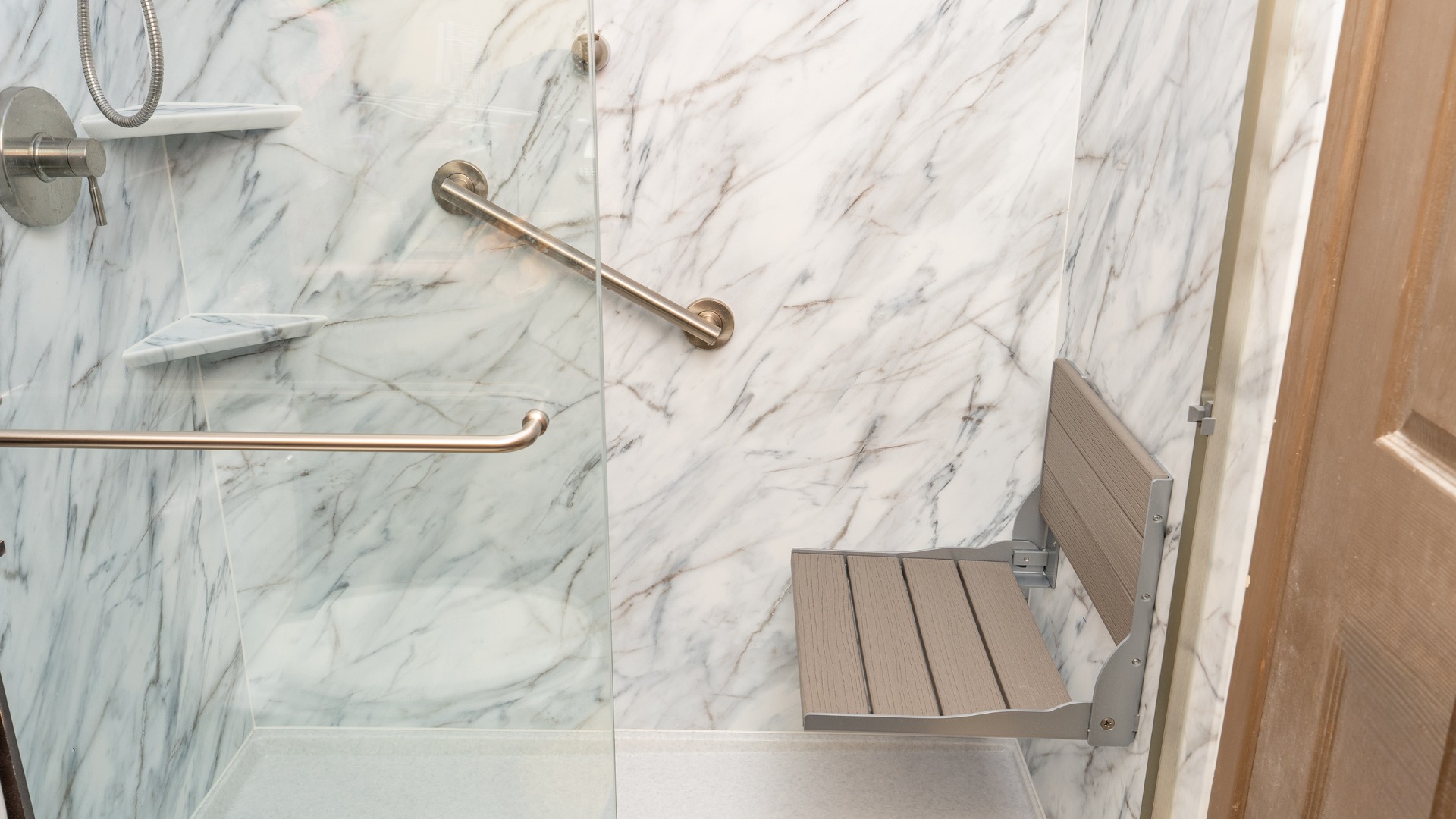
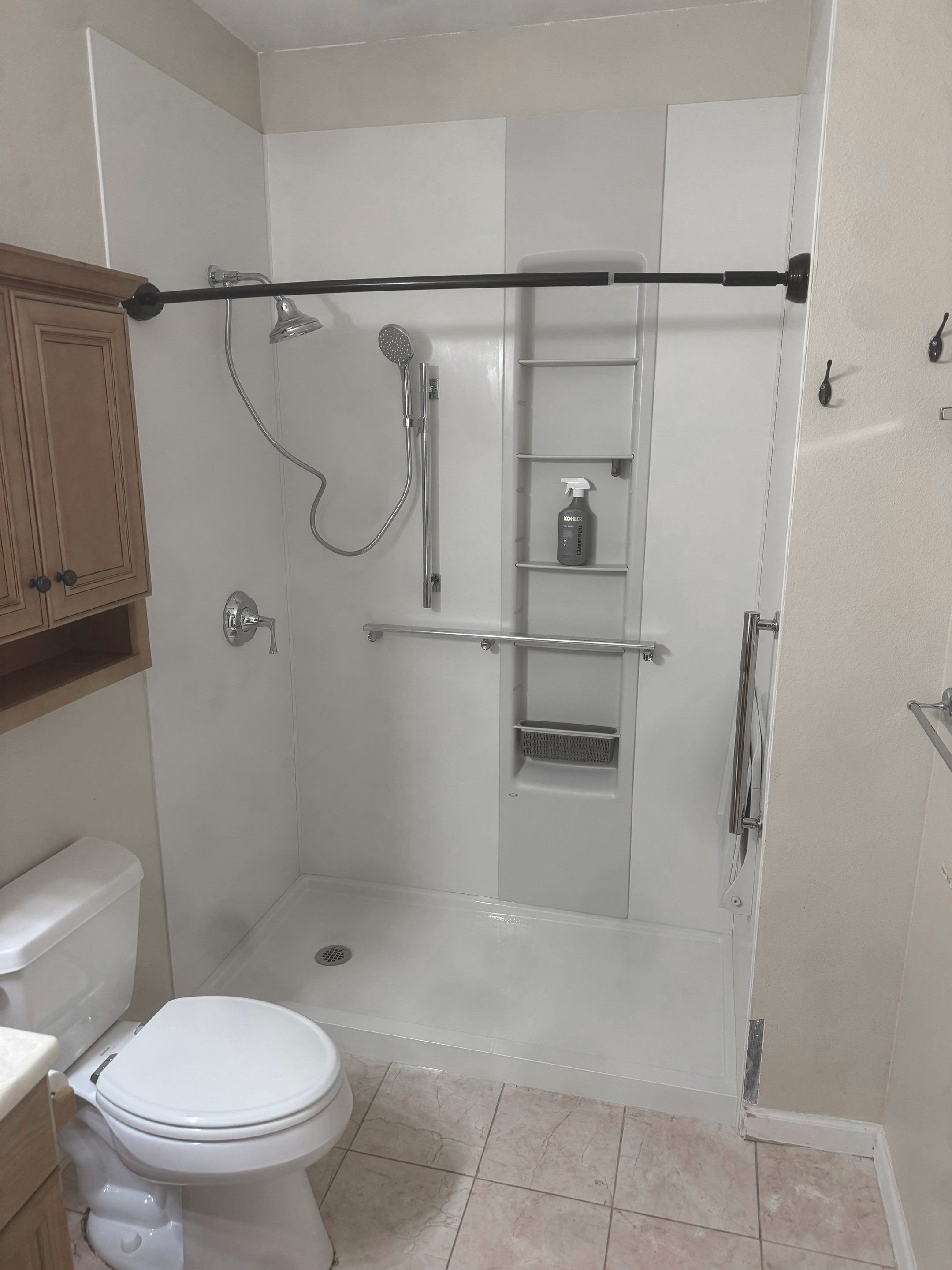
An accessibility-focused bathroom project is not a grab bar screwed into drywall. Done properly it addresses the whole sequence of getting into, through, and out of the room:
- A walk-in or curbless shower with a low or zero threshold
- Blocking behind the walls so grab bars anchor into structure, placed where the person actually reaches
- A built-in bench or fold-away seat
- A handshower on a slide bar, reachable from seated
- Slip-resistant flooring and shower base surfaces
- Comfort-height toilet
- Improved lighting, including at floor level
- Adequate door width and turning clearance
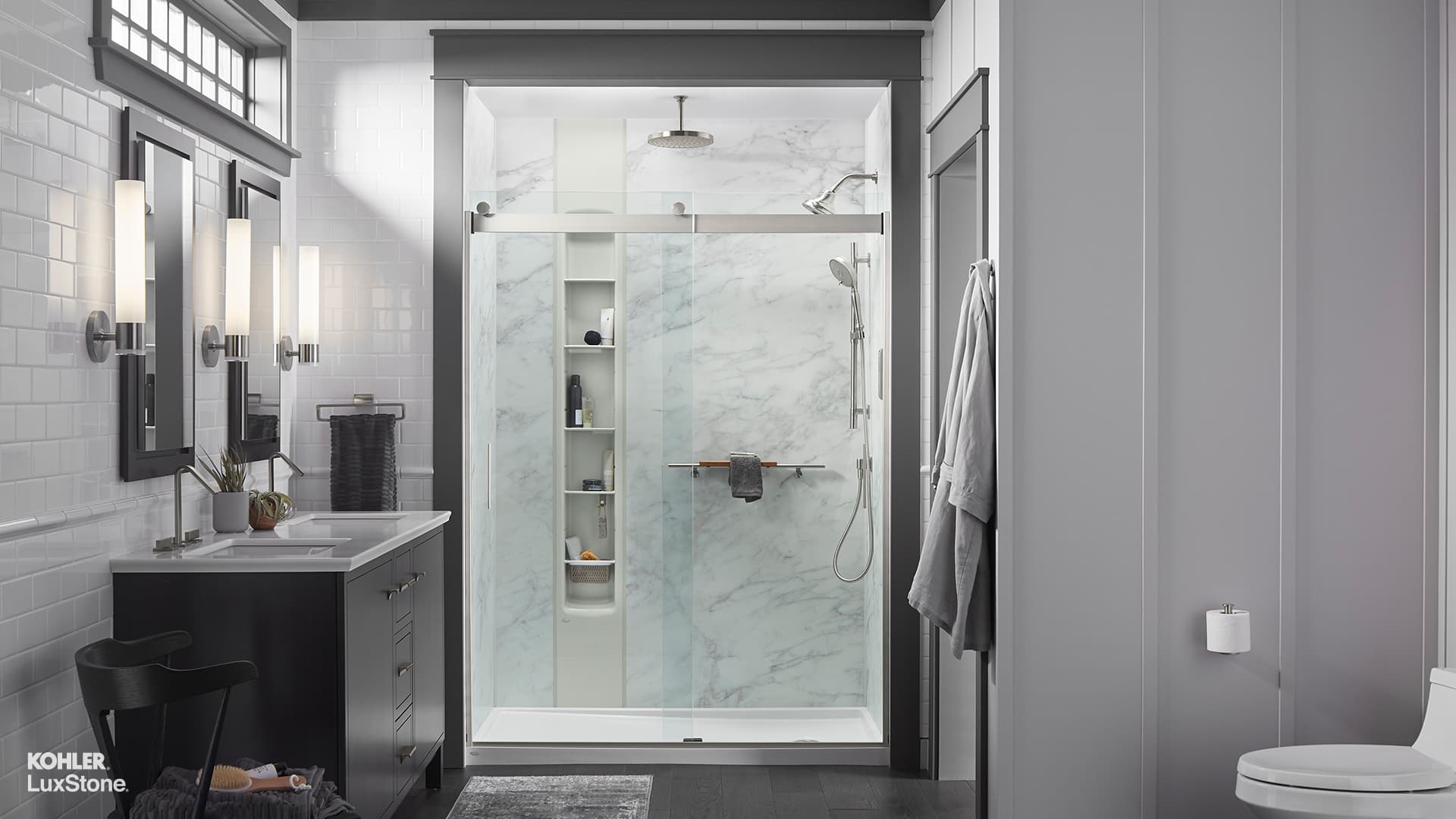
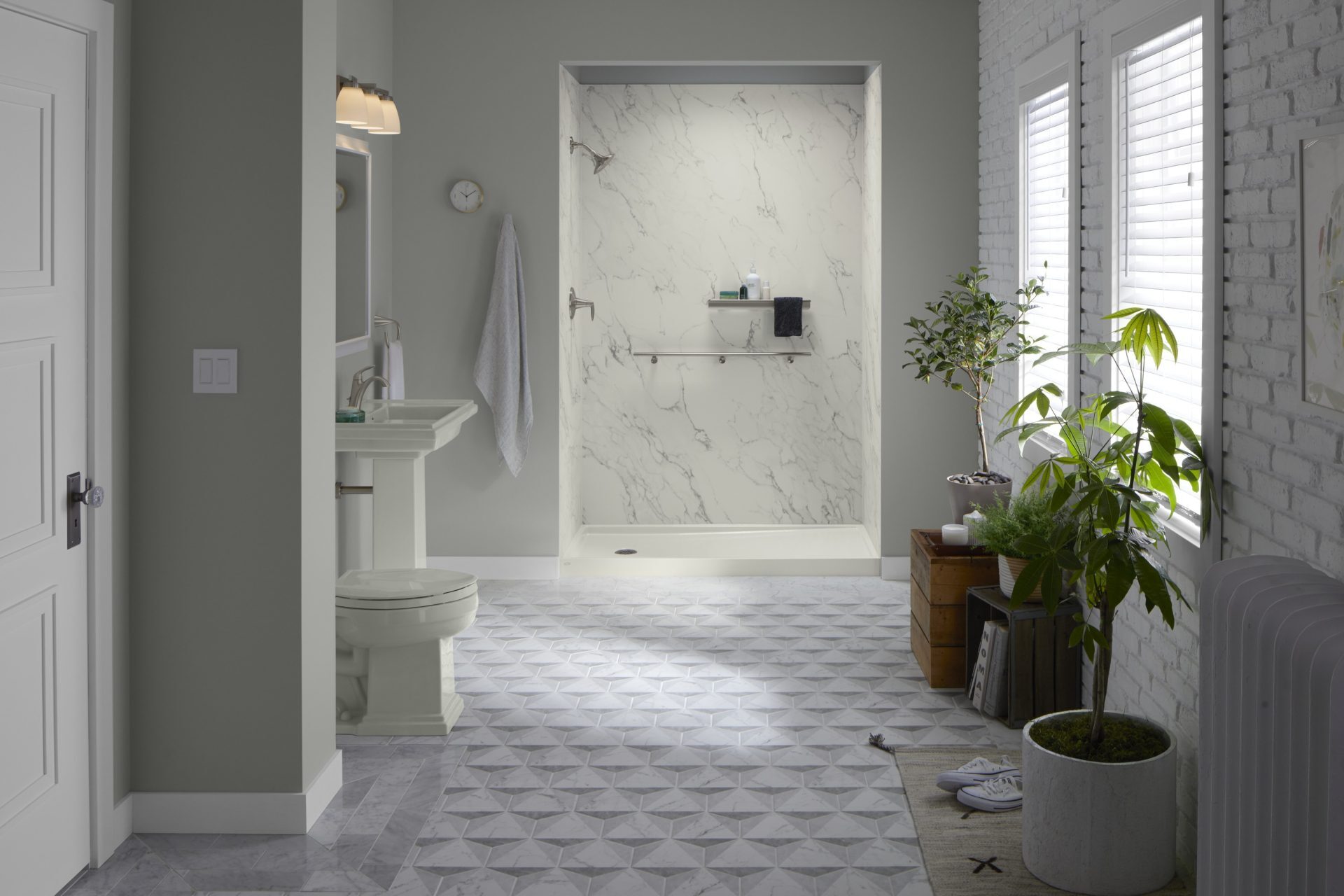
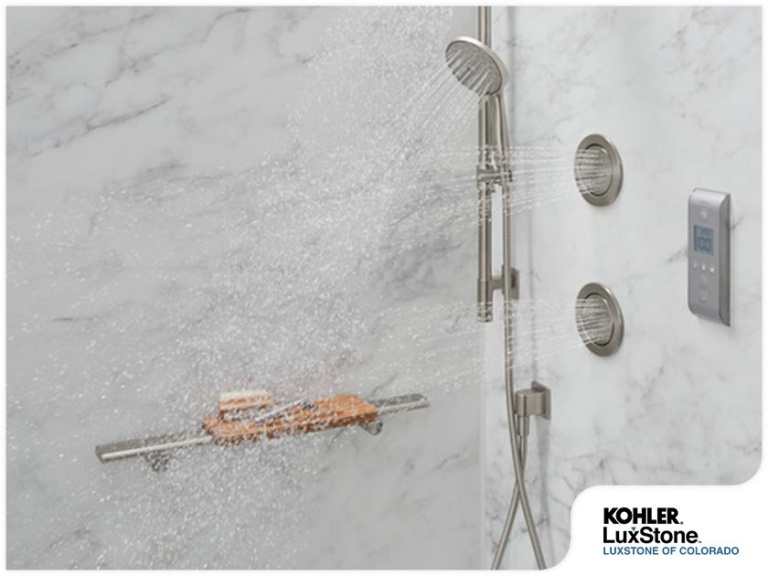
At HomePride we primarily install premium solid wall systems, including Reveal by KOHLER LuxStone walls, Onyx, and Samuel Müeller. In an accessibility project the reason is practical rather than cosmetic: the wall system, the base, the bench, and the grab bar anchoring are engineered to work together, rather than assembled from parts by whoever shows up.
Assisted living, and what the monthly rate does not include
An assisted living community typically provides an apartment, meals, housekeeping, utilities, activities, transportation, and basic help with daily tasks, with staff available around the clock.
The part families consistently miscalculate is what sits outside the base rate. Most communities price care in tiers, and the tier is assessed after move-in. Medication management, help with bathing and dressing, incontinence care, and mobility assistance frequently carry additional monthly charges. Memory care carries a significant premium over standard assisted living. Published estimates range from roughly 10 to 25 percent depending on the source, and no survey-based national figure exists, so ask any community you tour for their specific memory care rate rather than planning around a percentage. Many communities also charge a one-time community or move-in fee, and most raise rates annually.
When you ask a community what it costs, ask for the all-in number at the care level the person will actually be assessed at, plus the historical rate increase. The base rate on the brochure is not the number you will pay.
The Cost Comparison
What assisted living costs
The most widely cited source is the CareScout Cost of Care Survey, which collected more than 25,000 rates from providers nationwide between July and November 2025. Its national medians:
|
Care setting |
Monthly national median |
|
Adult day health care |
$2,058 |
|
Assisted living community |
$6,200 |
|
Non-medical caregiver at home, 44 hours per week |
$6,673 |
|
Nursing home, semi-private room |
$9,581 |
|
Nursing home, private room |
$10,798 |
The source publishes annual figures ($24,700 / $74,400 / $80,080 / $114,975 / $129,575); monthly figures shown are those divided by twelve.
Assisted living rose 5 percent over the prior year, which tracks closely with broader rental housing costs, since a large share of the monthly fee is room and board.
A note on Colorado numbers.The CareScout 2025 survey puts Colorado assisted living at $79,005 per year, or $6,584 per month, well above the national median. Referral networks publish lower Colorado figures, often near $5,200, because they report base rates from a self-selected set of partner communities rather than a survey median.
The figures differ because the sources measure different things. Survey-based data such as CareScout polls licensed providers directly and reports a median. Referral networks report averages from their own partner communities, which is a self-selected set. Some sources include care-level charges and some report base rent only. Denver and the mountain resort markets also run higher than the state as a whole, which pulls statewide averages in different directions depending on the sample.
The practical response is not to pick a number off a website. It is to call three communities near the person, ask each for the all-in monthly cost at their assessed care level, and build your plan on those three numbers.
A commonly cited average assisted living stay is about 22 months. At the monthly rates above, that puts the total cost of a typical stay somewhere between roughly $114,000 and $145,000, before accounting for future rate increases, care-level charges, move-in fees, or other community-specific costs.
What an accessibility bathroom remodel costs
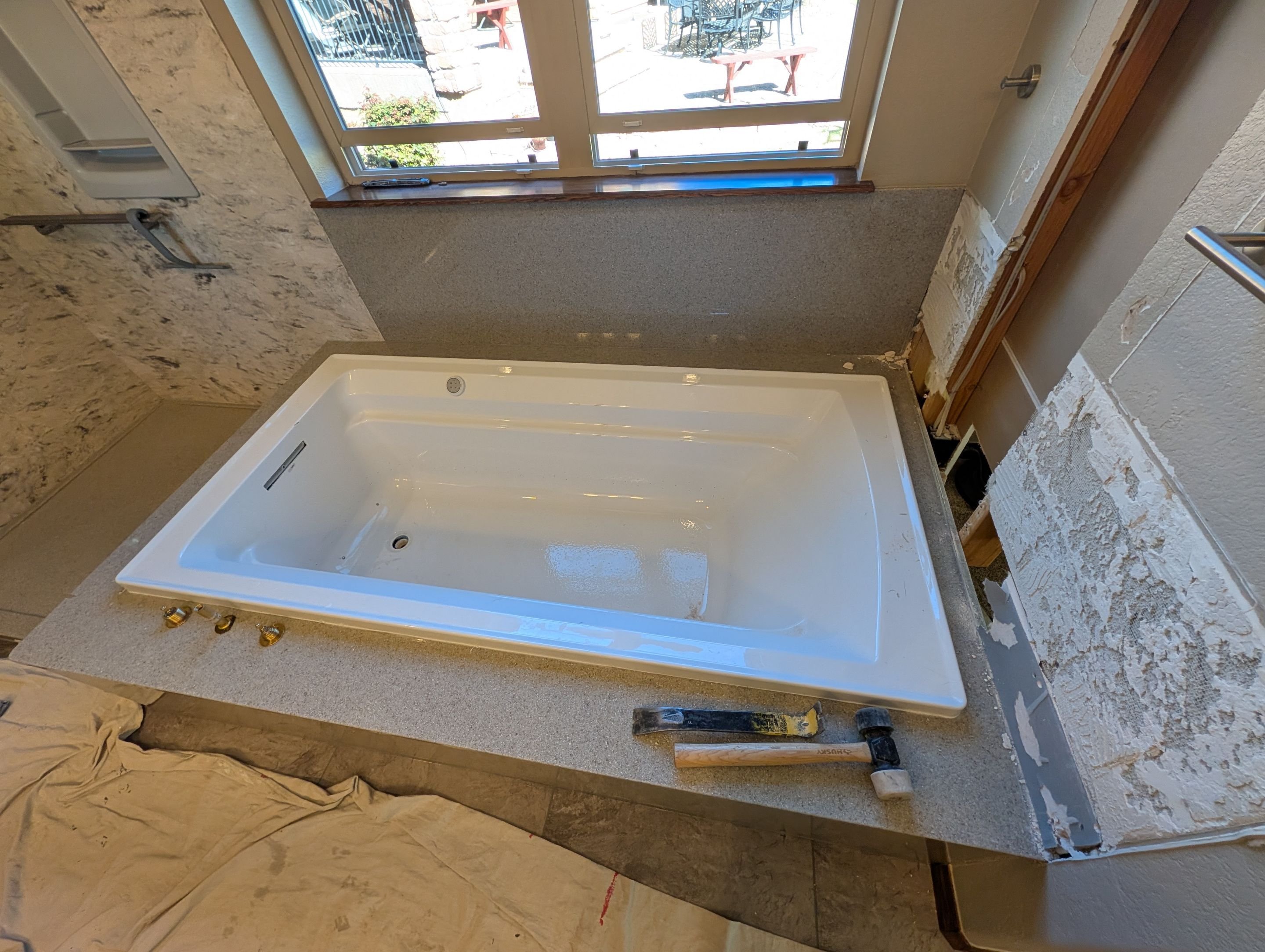
Here are our 2026 Colorado planning ranges for professionally installed projects:
|
Tier |
Colorado installed cost |
Typical timeline |
What changes |
|
Wet area, shower-only replacement |
$14,000 to $24,000 |
2 to 3 days |
Tub or shower removed and replaced with a walk-in shower, base, wall system, seating, grab bars, fixtures |
|
Midrange bathroom remodel |
$20,000 to $30,000 |
3 to 7 days |
Wet area plus vanity, comfort-height toilet, flooring, lighting |
|
Full bathroom remodel |
$35,000 to $60,000 |
2 to 4 weeks |
Layout, plumbing, electrical, framing, widened openings |
|
Luxury remodel |
$60,000 to $100,000+ |
8 to 14 weeks |
Expanded footprint, structural work, premium materials |
Most accessibility-driven projects land in the first two tiers. That surprises people who assume that accessibility is what makes a bathroom expensive. It is not. Layout changes are. A curbless entry, a bench, correct grab bar blocking, a handshower, and better lighting add relatively little when the shower stays in its existing footprint.
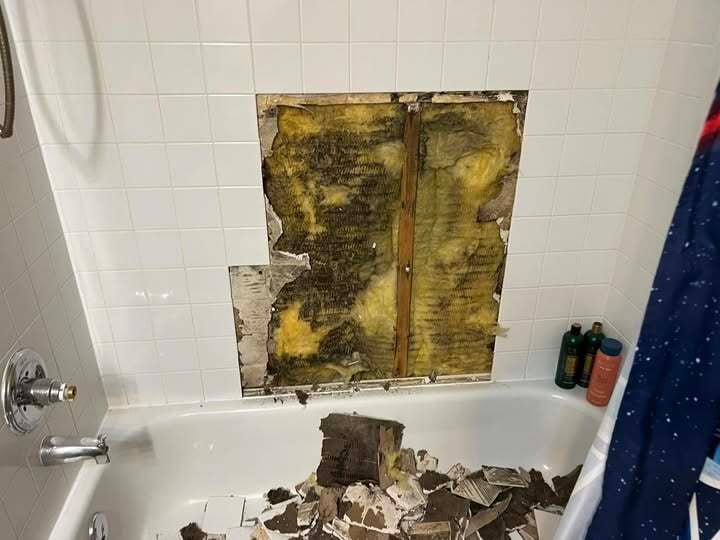
What pushes a project into the higher tiers is moving drains and supply lines, relocating a toilet or vanity, widening a doorway that requires reframing, working on a second floor, or discovering concealed water damage behind an existing enclosure. Mountain market labor and access can also move the number.
The single most effective cost control in any bathroom project is keeping the shower, toilet, vanity, drains, and electrical where they are. For a fuller breakdown, see our Colorado walk-in shower cost guide and Colorado bathroom remodeling permits guide.
The break-even math
Here is the comparison almost nobody publishes: how many months of assisted living equal one remodel.
|
Project |
At $5,200/mo |
At $6,200/mo |
At $6,584/mo |
|
Wet area conversion, $14,000 |
2.7 months |
2.3 months |
2.1 months |
|
Wet area conversion, $24,000 |
4.6 months |
3.9 months |
3.6 months |
|
Midrange remodel, $20,000 |
3.8 months |
3.2 months |
3.0 months |
|
Midrange remodel, $30,000 |
5.8 months |
4.8 months |
4.6 months |
|
Full remodel, $35,000 |
6.7 months |
5.6 months |
5.3 months |
|
Full remodel, $60,000 |
11.5 months |
9.7 months |
9.1 months |
And here is what assisted living accumulates to over time, at the national median:
|
Time horizon |
At a flat rate |
With 5% annual increases |
|
6 months |
$37,200 |
$37,200 |
|
1 year |
$74,400 |
$74,400 |
|
2 years |
$148,800 |
$152,520 |
|
5 years |
$372,000 |
$411,107 |
|
10 years |
$744,000 |
$935,795 |
In Colorado, the entire cost of converting a tub to an accessible walk-in shower is roughly two to four months of assisted living.
Now the honest counterweights, because those tables are not the whole picture.
- The remodel does not include food, utilities, property taxes, homeowners insurance, or home maintenance. Assisted living does.
- The remodel does not include care hours. If someone needs help bathing or dressing, that cost sits on top of the remodel and does not appear anywhere in the table above.
- Assisted living rates rise annually. A completed remodel does not.
- Home equity is preserved in one scenario and spent down in the other. For many families that is the largest number in the entire comparison and it never shows up on an invoice.
- If the person needs supervision rather than accessibility, none of this math applies.
Bottom Line on Cost
If bathroom accessibility is the primary obstacle to remaining at home, a remodel is usually dramatically less expensive than assisted living. A $14,000 to $24,000 accessible shower conversion represents roughly two to four months of assisted living at current Colorado rates.
But that comparison only works when the remodel actually solves the problem.
If the person also needs significant in-home care, medication assistance, overnight supervision, meal preparation, transportation, or help with several activities of daily living, those costs must be added to the home side of the equation. At that point, the financial difference between staying home and assisted living can narrow quickly.
Compare the total cost of safely living at home against the all-in cost of the appropriate care setting, not simply the cost of a bathroom against the advertised base rent of an assisted living community.
Who Pays for What
This is where most families lose the most money, because the assumptions are wrong in both directions.
Does Medicare pay for either one?
No. Medicare does not pay for assisted living, and Medicare does not pay for a bathroom remodel.
Medicare covers short-term skilled nursing care following a qualifying hospital stay, typically up to 100 days. It does not cover custodial care, which is help with bathing, dressing, eating, and moving around, and that is what most long-term care actually consists of. It also does not cover home modifications.
This is one of the most expensive misunderstandings in retirement planning, and it is worth confirming with your own plan before you build a budget on it.
Medicaid
Health First Colorado, the state's Medicaid program, can pay on both sides of this comparison, through different mechanisms.
On the remodel side, Colorado's Home Modification benefit is available through several Home and Community-Based Services waivers, including the Elderly, Blind, and Disabled waiver, which is the usual pathway for older adults. Covered modifications can include replacing a bathtub with an accessible shower and adding grab bars as part of a larger project. The governing rule is that the modification must be a cost-effective means of meeting the participant's documented medical need that also ensures health, welfare, and safety. Their goal is to provide residents greater independence in the home and/or prevent institutionalization.
On the care side, Colorado Medicaid can pay for care delivered within a residence holding Alternative Care Facility certification. It does not pay the room and board portion in the way many families expect.
Both pathways require two determinations: a functional test establishing that the person needs a nursing-facility level of care, and a financial eligibility test under the state's long-term care rules. Waitlists exist. Start early.
Current program details are published at hcpf.colorado.gov. We cover the remodel pathway in detail in our guide to Colorado Medicaid coverage for walk-in showers and home modifications.
VA benefits
Veterans and surviving spouses have options on both sides. On the home modification side, the Specially Adapted Housing, Special Home Adaptation, and Temporary Residence Adaptation grants can fund accessibility work. On the care side, the Aid and Attendance benefit can offset assisted living costs.
These are separate programs with separate eligibility rules, and a veteran may qualify for more than one over time. Our VA funding guide for bathroom remodeling covers the home modification grants, current award amounts, and the application sequence.
For a full breakdown on VA benefits that assist veterans with home remodeling and/or bathroom modifications, read our full article: VA Funding for Bathroom Remodeling: A Veteran’s Guide (2026 Update)
Everything else
- Long-term care insurance. If a policy exists, read what it actually covers. Some policies pay for home modifications, and many families never check.
- Home equity. A HELOC or cash-out refinance is a common funding path for a remodel, and it keeps the asset in the family rather than converting it to monthly rent.
- Contractor financing. Ask what the total cost of financing is, not just the monthly payment.
- Tax treatment. Medically necessary home modifications may be deductible as a medical expense to the extent they exceed the increase in the home's value, and some assisted living costs may be deductible when care is medically necessary. Both rules have real conditions attached. Talk to a CPA rather than a contractor or a community sales director about this.

The Quality of Life Comparison
Cost is the easier half of this decision. The harder half is what each option does to a person's daily life, and an honest look at that does not favor one answer.
What staying home gives you
Autonomy is the big one. Eating when you want, sleeping when you want, keeping your own hours, having the dog. Familiar environments also matter more, not less, as cognition changes, because a person navigates a known space on memory that outlasts other kinds.
Then there are the connections a home carries with it. Neighbors who notice. The same church. Grandchildren who can come by without a visiting schedule. And there is predictability: a completed remodel is a fixed cost, while a monthly rate is an obligation that grows.
AARP's 2024 Home and Community Preferences Survey found that 75 percent of adults aged 50 and older want to remain in their current homes as they age, and 73 percent want to stay in their communities. Among those planning modifications to make that possible, 72 percent named the bathroom first. It is the room that fails first and the room people identify as the obstacle.
What staying home costs you that nobody mentions
Isolation is a genuine health risk, and a renovated bathroom does nothing about it. If the person is already spending most days alone, the house is part of the problem.
Meals, transportation, and home maintenance still have to happen, and somebody has to do them. In practice that somebody is usually an adult child. Family caregiving is real work with real costs, and leaving it off the ledger is the mirror image of the mistake families make when they only look at an assisted living brochure.
Emergencies also happen with nobody in the building. A medical alert system helps and does not fully answer it.
What assisted living gives you
Social contact is built into the day rather than dependent on someone initiating it. Meals are handled. Staff are on-site around the clock. Maintenance disappears. Transportation to appointments is arranged.
And for a family caregiver who is running out of capacity, relief is not an indulgence. Caregiver burnout is one of the most common reasons a move happens, and it is a legitimate reason on its own.
What assisted living costs you
The loss of control over small daily things is what people report missing, more than the house itself. Downsizing a lifetime of belongings is genuinely hard. There is a real adjustment period, often several months. Rates rise every year. And if care needs escalate past what the community provides, there is another move.
The reframe worth sitting with
In our experience the bathroom is usually the trigger event, not the underlying issue. Someone has a close call getting out of the tub, the family gets scared, and within a week the conversation has jumped to touring communities.
Sometimes that jump is correct. But if the bathroom is genuinely the only thing failing, you are solving a bathroom problem with a housing decision, and that is an expensive way to solve a bathroom problem.
Bottom Line on Quality of Life
Neither option automatically provides a better quality of life.
Staying home can preserve independence, familiar routines, pets, neighbors, community connections and control over daily life. But it can also increase isolation, home-maintenance responsibilities and dependence on family caregivers.
Assisted living can provide social contact, meals, transportation, maintenance and around-the-clock staff availability. But it also requires giving up some independence, downsizing possessions and adjusting to a new environment.
The better option is the one that safely supports the person's actual needs while preserving as much independence, connection and dignity as possible.

The Option Nobody Compares: Remodel Plus In-Home Care
Almost every article treats this as a binary. It is not one, and the hybrid is what a lot of families actually end up doing.
Take a $19,000 wet area conversion paired with 20 hours per week of non-medical in-home care. At the CareScout national median of roughly $35 per hour, 20 hours per week runs about $3,030 per month, which is meaningfully less than the $6,200 assisted living median, and it comes with the house, the neighborhood, and the routines attached.
There is a second effect worth naming. Bathing assistance is one of the largest line items in a home care plan, because it is time-consuming and often requires two hands or two people. An accessible shower with a bench, a handshower, and properly anchored grab bars can change what one aide, or one spouse, can safely manage alone. The remodel does not just sit alongside the care plan. It can reduce the hours the care plan requires.
The honest ceiling: this stops working as hours climb. At full-time daytime care of 44 hours per week, roughly $6,673 per month at the national median, in-home care costs more than assisted living and delivers less social contact and no overnight coverage. Past that point, assisted living usually wins on both cost and quality of life, and it is the right call.
Bottom Line on the Hybrid Option
For someone who needs help but not continuous supervision, remodeling plus part-time in-home care can create a useful middle ground between complete independence and assisted living.
The key number to watch is not simply the caregiver's hourly rate. It is the total number of care hours required each week. As those hours increase, the cost advantage of staying home gradually disappears.
That is why families should price all three options whenever possible:
- Remodeling and remaining largely independent
- Remodeling plus the realistic amount of in-home care required
- Assisted living at the person's actual assessed care level
For many families, the right answer becomes much clearer once all three numbers are placed side by side.

When Assisted Living Is the Right Answer
We remodel bathrooms for a living, but there are situations in which we would rather tell a family not to remodel than sell them a project that will not solve the real problem.
If several of the following describe your situation, assisted living, memory care, or another supported care setting deserves serious consideration:
- Cognitive decline, wandering risk, or a dementia diagnosis. No bathroom solves supervision. This is the clearest disqualifier there is.
- Help needed with multiple activities of daily living, not just bathing. If dressing, eating, toileting, and transferring all require assistance, you are looking at a care problem, not an access problem.
- Medication management is failing. Missed doses, doubled doses, and confusion about what was taken when.
- Overnight needs. If someone requires help at 3 a.m., a bathroom does not provide it and most families cannot sustain providing it.
- The primary family caregiver is at their limit. This alone is enough. A caregiver who is losing their health, their job, or their marriage is not a sustainable care plan.
- Isolation is already causing measurable decline. Weight loss, withdrawal, missed appointments, a house going untended.
- The home has other disqualifying problems. Stairs to every entrance, a bedroom only on the second floor, or a rural location far from medical care. A perfect bathroom in an impossible house is still an impossible house.
- Care needs are on a steep trajectory rather than a stable plateau. If the last six months brought three new limitations, plan for the next six.
If that list describes your parent, spend the money on the right care setting instead. We will tell you the same thing at the estimate.
When the Remodel Is the Right Answer
A remodel becomes much easier to justify when the person's independence is being limited primarily by the physical environment rather than by the need for ongoing care.
In other words, if the person can still manage daily life but the bathtub, shower, doorway or bathroom layout has become the obstacle, changing the environment may solve the actual problem without requiring a move.
The mirror image is just as clear:
- Mobility, balance, or strength is the issue, and cognition is intact
- The person manages daily life independently when the environment cooperates
- They want to stay, and the family agrees rather than merely deferring
- The rest of the home works: entry access, a main-floor bedroom, a livable kitchen
- Care needs are stable rather than escalating
- There is a spouse, a nearby family member, or a reliable check-in
- Home equity is an asset the family wants to preserve
If most of those are true, a remodel is very likely the cheaper and better answer, and the tables above show by how much.
What If We Remodel and End Up Moving Anyway?
This is the objection that stops most families, and it deserves a straight answer.
First, an accessible bathroom is one of the more durable improvements a home can have. Buyer demand for accessible, single-level features is growing as the population ages, and a well-designed walk-in shower typically reads as a modern bathroom improvement rather than a medical adaptation.
According to the Journal of Light Construction's 2025 Cost vs. Value Report, a midrange bathroom remodel can recover a substantial portion of its cost in resale value. That does not mean every accessibility project will produce the same return, but it does mean the investment is not necessarily lost simply because the homeowner eventually moves.
Second, and more directly: delaying a move by even six months roughly covers a wet area conversion at Colorado assisted living rates. A remodel that buys two more years at home has paid for itself several times over, whatever happens afterward.
Third, the timing itself has value. Families who plan ahead choose. Families who wait decide during a hospital discharge, in three days, with whatever placement is available.
On bathroom safety data. The most frequently cited federal study on this is a CDC analysis of 2008 emergency department data, published in 2011, which found roughly 234,000 non-fatal bathroom injuries treated in U.S. emergency departments annually among people aged 15 and older. About 81 percent were caused by falls, and roughly 37 percent occurred while bathing, showering, or getting in or out of the tub or shower. We cite the study year deliberately, because it is often quoted as though it were current data. The pattern it identifies has held up in later research: the tub or shower transition is where bathroom injuries concentrate.

How to Actually Make This Decision
If your family is actively deciding between remodeling, in-home care and assisted living, do not start with a contractor or an assisted living salesperson. Start by identifying the actual care problem, then compare the real costs.
Use these five steps, in order:
1. Get a clinical read, not a sales read. An occupational therapist evaluation or a walkthrough by a Certified Aging in Place Specialist will tell you what the person's actual functional limitations are. Neither a contractor nor a community sales director is the right first opinion.
2. Price three local assisted living communities. Ask each for the all-in monthly cost at the care level the person would be assessed at, plus the move-in fee and the last three years of rate increases. Not the base rate.
3. Get a fixed-price bathroom quote with a timeline, including how concealed conditions will be documented, priced, and approved if they turn up after demolition.
4. Put all three options on one page over a five-year horizon. Compare staying home after the remodel, remodeling plus the realistic amount of in-home care required, and assisted living at the person's assessed care level. Include annual community rate increases, home maintenance, care hours and any move-in or service fees. Comparing only the remodel price against assisted living rent leaves out too much of the real decision.
5. Ask the person whose bathroom it is what they want. This gets skipped more often than any other step in the process.
Questions to Answer Before You Decide
Before making the final decision, your family should be able to answer these questions:
- Is the primary problem accessibility, ongoing care, supervision, or a combination of the three?
- How many activities of daily living currently require assistance?
- Are those needs stable, or have they changed significantly during the past six months?
- Can the person safely remain alone for several hours?
- Is medication being managed reliably?
- Is overnight assistance needed?
- How many hours of paid or family caregiving are realistically available each week?
- Does the rest of the home support aging in place, including the entrance, bedroom, kitchen and stairs?
- What does the person who will actually be living with this decision want?
- What will each realistic option cost over one, three and five years?
If your family cannot confidently answer those questions yet, you probably need more information before making either a remodeling or assisted living decision.
Where to Start
You do not need to decide between remodeling and assisted living before you have the real numbers.
Start by identifying what problem you are trying to solve. If the primary issue is mobility, balance or bathroom access, an accessibility remodel may allow the person to remain safely at home for years. If the primary issue is supervision, memory, medication management, overnight assistance or increasing help with daily activities, the better answer may be a supported care setting.
If bathroom accessibility is part of the problem, HomePride Bath can help you determine what it would actually cost to make the space safer.
During a free in-home accessibility consultation, we can evaluate the existing bathroom, discuss the person's mobility and accessibility needs, identify an appropriate project scope, and provide a project-specific price you can compare directly with the cost of in-home care or assisted living.
HomePride Bath is a Reveal by KOHLER Authorized Dealer serving homeowners throughout Colorado and Cheyenne, with experience designing bathrooms around accessibility, aging in place and long-term usability.
Schedule your free in-home accessibility consultation
Cost figures for care settings are from the CareScout 2025 Cost of Care Survey unless otherwise noted. Home and community preference data is from AARP's 2024 Home and Community Preferences Survey. Bathroom injury data is from a CDC analysis of 2008 emergency department data published in 2011. Colorado remodeling ranges are HomePride planning ranges for professionally managed projects, not bids. Medicaid and VA program details change; confirm current rules with the administering agency.
Frequently Asked Questions about Remodeling vs. Assisted Living
Q1. Does Medicare pay for assisted living? No. Medicare covers short-term skilled nursing following a qualifying hospital stay, generally up to 100 days. It does not cover the room, board, or custodial care that assisted living provides.
Q2. Does Medicare pay for a walk-in shower? No. Medicare does not cover home modifications. It may cover certain durable medical equipment prescribed by a physician, which is a different category from a bathroom remodel.
Q3. Will Medicaid pay for a bathroom remodel in Colorado? It can. Colorado's Home Modification benefit is available through several HCBS waivers, including the Elderly, Blind, and Disabled waiver, and can cover replacing a tub with an accessible shower when it is the most cost-effective way to meet a documented medical need. Eligibility requires both a nursing-facility level of care determination and financial qualification.
Q4. How much does assisted living cost in Colorado? Published figures range from roughly $5,200 to $6,600 per month depending on the source and what is included. The national median is $6,200 per month per the CareScout 2025 Cost of Care Survey. Price three local communities rather than planning around a published average.
Q5. Is a bathroom remodel cheaper than assisted living? For most people, substantially. A $14,000 to $24,000 wet area conversion in Colorado equals roughly two to four months of assisted living. The comparison changes if the person also needs ongoing care hours, and it does not apply at all if they need supervision or memory care.
Q6. Are assisted living costs or home modifications tax deductible? Both may be, under conditions. Medically necessary home modifications may be deductible as a medical expense to the extent the cost exceeds any increase in the home's value, and assisted living costs may be partially deductible when care is medically necessary. Consult a CPA.
Q7. How much does it cost to make a bathroom safe for an elderly parent? In Colorado, a professionally installed wet area conversion with a walk-in shower, bench, grab bars, handshower, and slip-resistant surfaces typically runs $14,000 to $24,000. Adding a comfort-height toilet, new flooring, and improved lighting moves it toward $20,000 to $30,000.
Q8. How long does an accessibility bathroom remodel take? A wet area replacement typically takes two to three days on site. A midrange remodel runs three to seven days. Full remodels involving layout or plumbing changes take two to four weeks.
Q9. When should someone move to assisted living instead of remodeling? When the need is supervision rather than access. Cognitive decline, wandering risk, failing medication management, overnight needs, help required with multiple daily activities, or a family caregiver at their limit all point toward a community rather than a remodel.
Q10. Does an accessible bathroom hurt resale value? Not when it is designed well. A curbless shower with a bench and integrated grab bars reads as a contemporary upgrade rather than a medical fixture. Consider the whole home's bathroom mix before removing the only bathtub in the house.
Sources
- CareScout, Cost of Care Survey 2025 https://www.carescout.com/cost-of-care State-level medians (PDF): https://assets.carescout.com/x/8fcb50422f/282102.pdf
- CareScout, CareScout Releases 2025 Cost of Care Survey Results, March 2026 https://investor.genworth.com/news-events/press-releases/detail/1054/carescout-releases-2025-cost-of-care-survey-results
- U.S. News & World Report, Assisted Living Costs: A Guide to Expenses and Payment Options, citing AHCA/NCAL length-of-stay data https://health.usnews.com/best-senior-living/assisted-living/articles/assisted-living-costs
- U.S. News & World Report, How Much Does Memory Care Cost? https://health.usnews.com/best-senior-living/memory-care/articles/how-much-does-memory-care-cost
Medicare
- Medicare.gov, Skilled nursing facility (SNF) care https://www.medicare.gov/coverage/skilled-nursing-facility-care
- Medicare.gov, Nursing home care https://www.medicare.gov/coverage/nursing-home-care
Colorado Medicaid
- Colorado Department of Health Care Policy and Financing, Home Modification Benefit https://hcpf.colorado.gov/home-modification-benefit
- Colorado Department of Health Care Policy and Financing, Elderly, Blind and Disabled (EBD) Waiver https://hcpf.colorado.gov/elderly-blind-disabled-waiver-ebd
- Colorado Department of Health Care Policy and Financing, Home and Community-Based Services Waivers https://hcpf.colorado.gov/hcbs-waivers
- Colorado Department of Public Health and Environment, Assisted Living Residences https://cdphe.colorado.gov/assisted-living-residences
Veterans benefits
- U.S. Department of Veterans Affairs, Housing grants for Veterans with service-connected disabilities https://www.va.gov/housing-assistance/disability-housing-grants/
- U.S. Department of Veterans Affairs, VA Aid and Attendance benefits and Housebound allowance https://www.va.gov/pension/aid-attendance-housebound/
Tax treatment
- Internal Revenue Service, Publication 502: Medical and Dental Expenses https://www.irs.gov/publications/p502
Aging in place and caregiving
- AARP, 2024 Home and Community Preferences Survey https://www.aarp.org/pri/topics/livable-communities/housing/2024-home-community-preferences/
- AARP, Research Insights on Livable Communities https://www.aarp.org/pri/topics/livable-communities/aarp-research-insights-livable-communities/
- AARP and the National Alliance for Caregiving, Caregiving in the U.S. https://www.aarp.org/pri/topics/ltss/family-caregiving/caregiving-in-the-united-states/
- National Academies of Sciences, Engineering, and Medicine, Social Isolation and Loneliness in Older Adults, 2020 https://www.nationalacademies.org/our-work/the-health-and-medical-dimensions-of-social-isolation-and-loneliness-in-older-adults
- Administration for Community Living, Eldercare Locator https://eldercare.acl.gov
Bathroom safety
- Centers for Disease Control and Prevention, Nonfatal Bathroom Injuries Among Persons Aged ≥15 Years, United States, 2008. MMWR, June 10, 2011, Vol. 60, No. 22, pp. 729 to 733 https://www.cdc.gov/mmwr/pdf/wk/mm6022.pdf
Related HomePride guides
Topics: