
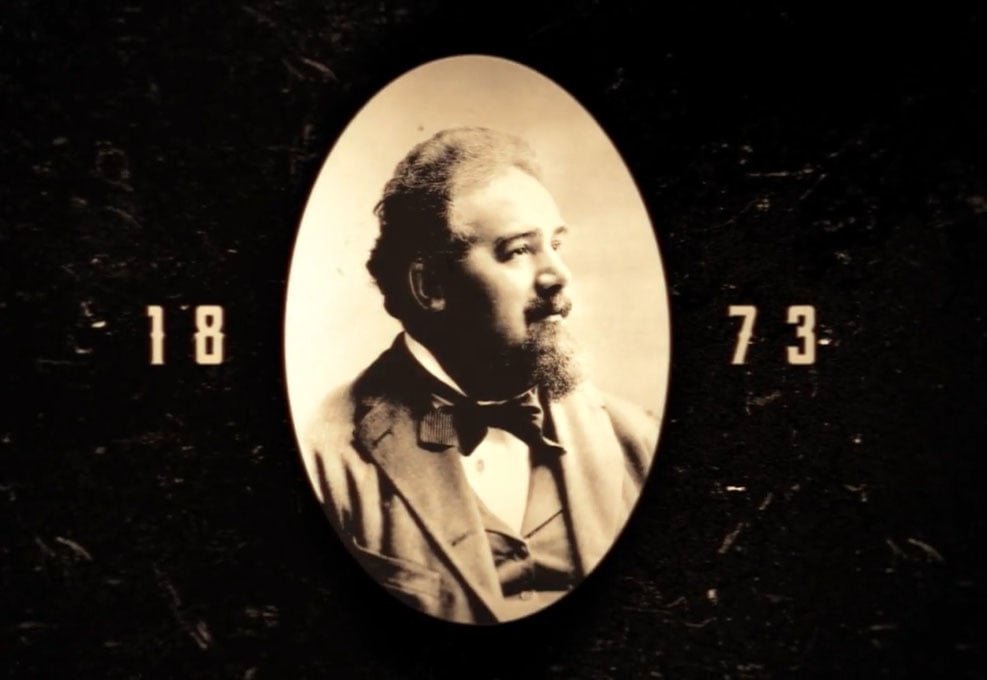
Picture this: it’s 1883. The US has a population of 50 million people, under the leadership of President Chester A. Arthur. The Northern Pacific Railway was completed, connecting Minnesota to the Pacific Northwest and opening up trade and new regions for development. Standardized time zones were put into place across the country and Canada, ending the chaos of every town keeping its own time. And, after 14 years of construction, the Brooklyn Bridge finally opened—the longest suspension bridge for its time, as 150,000 awestruck people crossed it on its first day.

American innovation and craftsmanship were at their height, as new Edison lightbulbs were being adopted on streetways in New York and San Francisco, lighting the way for hundreds of thousands of citizens who prior had relied on gaslamps to guide their way. In a small ironworks factory in Wisconsin, another major innovation would also be introduced. One that would change American homes forever.
In just a moment, we’re going to cover the 153-year old history of Kohler. You may be asking yourself: “So why are you telling this story?” Because when you remodel your bathroom, you’re not just choosing a product—you’re choosing the company behind it. Knowing more about its history may help you make an informed, educated decision that will affect you and your family for years to come.
From $5,000 and a Dream: The Founding Story
Let’s return to 1883, and travel to rural Wisconsin. Not the Wisconsin of craft breweries, the Green Bay Packers, and incredible cheese curds. But a place of iron foundries, horse-drawn wagons, and farm fields that stretched into forever. The economy is collapsing. Most people are holding tight to whatever they have.
And then there’s John Michael Kohler.
At 29, this Austrian immigrant made a choice that polite society might’ve called… bold, risky, maybe even foolish. He purchased the Sheboygan Union Iron & Steel Foundry from his father-in-law for $5,000—about $130,000 today.
His backstory is gritty in the way all great American entrepreneurial stories are. Born in Schnepfau, Austria. Emigrated at age 10. Left his father’s violent household early. Worked as a delivery driver, then a salesman grinding out nine years of routes in Chicago. Eventually landed in Wisconsin, met a schoolteacher named Lillie Vollrath, married her, and joined the family business.
The foundry didn’t make glamorous things. It made what farmers needed to survive: plows, harrows, and iron troughs. But Kohler saw possibility where others saw only practicality.
And according to the company’s own archives, he carried “an independent spirit… an artist and craftsman whose passion to create and innovate” laid the foundation for the family legacy that followed.
1883: The Idea That Changed Everything
Ten years into running the company, Kohler had an idea that would change American bathrooms forever. He was standing in his noisy, soot-covered iron works supplying the essentials of Midwestern farm life: plows, kettles, troughs, the everyday cast-iron stuff that kept people fed and fields plowed.
But Kohler? He wasn’t wired to settle for necessary.
He had a mind that tinkered. That wandered. That saw possibility in the most ordinary things.
And that’s when it happened.
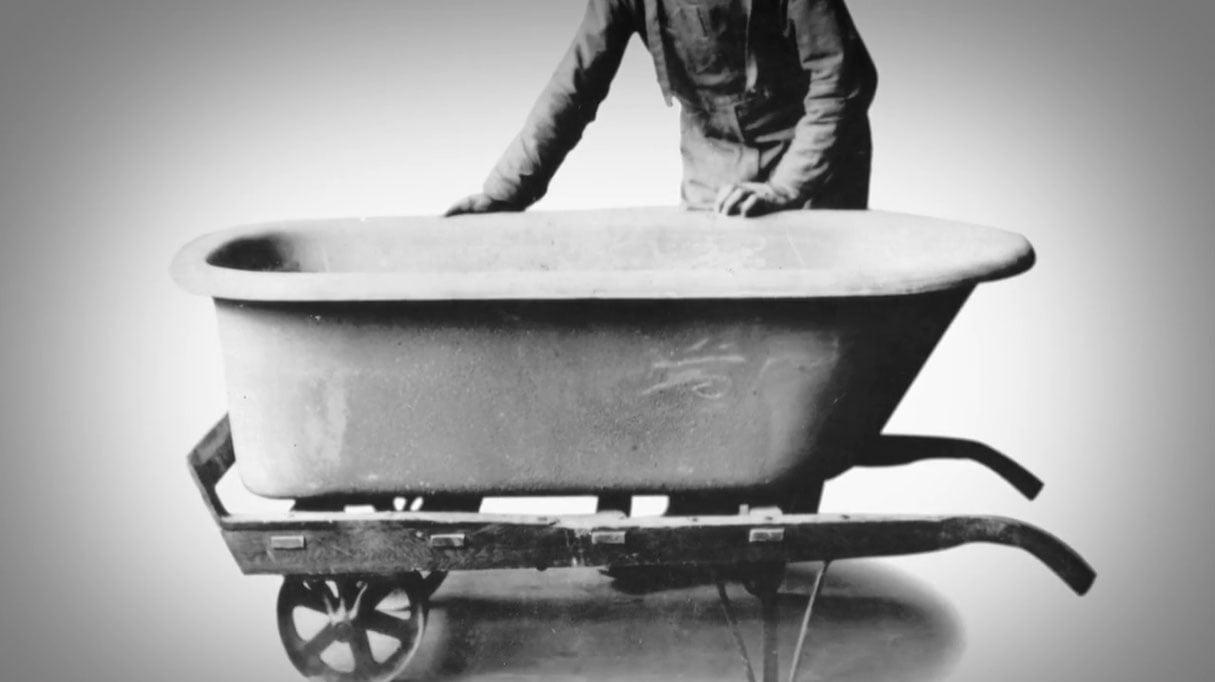
One day he took a thick, cast-iron horse trough—something designed for barnyards and livestock—and pushed it into a furnace until it glowed the color of sunrise metal, about 1,700 degrees hot. Then, with a kind of casual genius that looks almost improvised, he dusted it with white enamel (a technique he learned from his brother-in-law, who brought it from Germany).
The enamel melted.
It fused.
It transformed.
A farm trough suddenly looked… refined. Smooth. Clean. Inviting, even.
And in that simple act, equal parts craftsmanship, curiosity, and a touch of audacity, the first American enameled bathtub was born.
Why did he do it?
Because Kohler believed something quietly radical for his time: that everyday life deserved beauty. That utility could also be comfort. That the home deserved the same thoughtful design as a cathedral or a sculpture.
And because he was a businessman with great timing.
Indoor plumbing was beginning to trickle into American homes. Cities were growing. People were thinking differently about cleanliness, hygiene, and the rituals of daily life. Kohler didn’t just make a product; he caught a wave of cultural change.
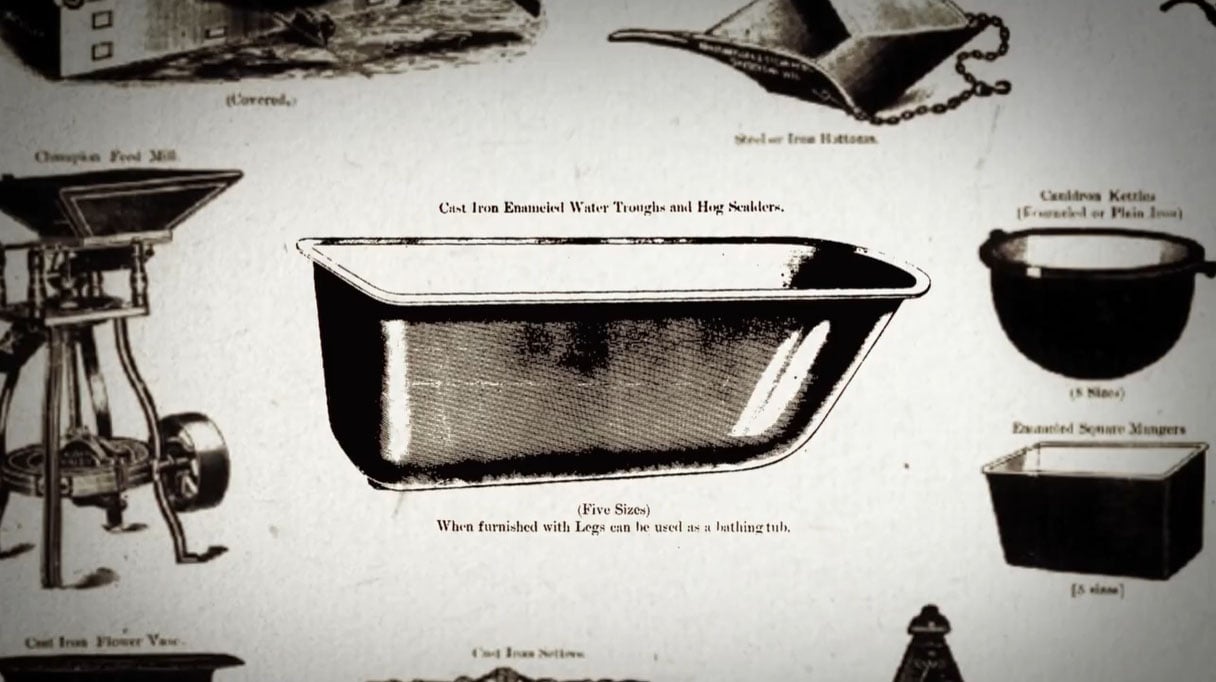
His catalog description was humble—almost funny in hindsight:
“A horse trough/hog scalder… when furnished with four legs, will serve as a bathtub.”
Not exactly Madison Avenue copywriting. But, American homeowners understood instantly. More importantly — they wanted it.
That moment: one glowing horse trough, one handful of enamel—didn’t just create a bathtub. It set Kohler on a 153-year path of reimagining what the American bathroom could be.
Surviving Tragedy: Resilience in the Early 1900s
The enormous demand for these new ceramic tubs and success brought momentum, and momentum brought change. By the turn of the century, Kohler’s original Sheboygan factory, once perfectly sized for plows and iron kettles, was now bursting at the seams. Demand for enameled plumbing fixtures was rising fast, and the company needed room to grow.
So John Michael Kohler did what bold founders do: he planned a larger, more modern foundry in the nearby community of Riverside. It was a moment of optimism, expansion, and the kind of forward-looking energy that defines a company on the rise.
And then came the one-two punch that could have ended everything.
November 1900: John Michael Kohler, the immigrant entrepreneur who had built the company from a $5,000 gamble, died suddenly at just 56 years old. His death alone was destabilizing enough—losing a founder is like losing a compass. But before the company had time to grieve, regroup, or even fully understand the loss, disaster struck again.
February 1901: the brand-new foundry—the beacon of their future—burned to the ground in a catastrophic fire. In the span of three months, Kohler lost its leader and its next-generation manufacturing facility. It was the kind of blow that would have pushed many companies into the history books as footnotes.
But the Kohler family didn’t fold. They doubled down. In the face of grief, uncertainty, and a literal pile of ashes, the family chose resilience.
John Michael’s three oldest sons—Robert, Walter, and Carl—stepped in with a steady, almost stubborn resolve. In 1902, they formally reorganized the company as J.M. Kohler Sons Company, purchasing the remaining interests and recommitting to their father’s vision. They rebuilt the foundry. They rehired workers. And they restarted production with a focus sharper than ever.
Their determination paid off. Not only did the business survive—it thrived. The rebuilt company expanded its plumbing line, improved its enameling processes, and grew its workforce. Over time, Kohler earned a reputation that still echoes today: a company whose products are durable because the people behind them are durable. A leadership defined not just by innovation, but by endurance. And a family business that refused to let tragedy dictate its destiny.
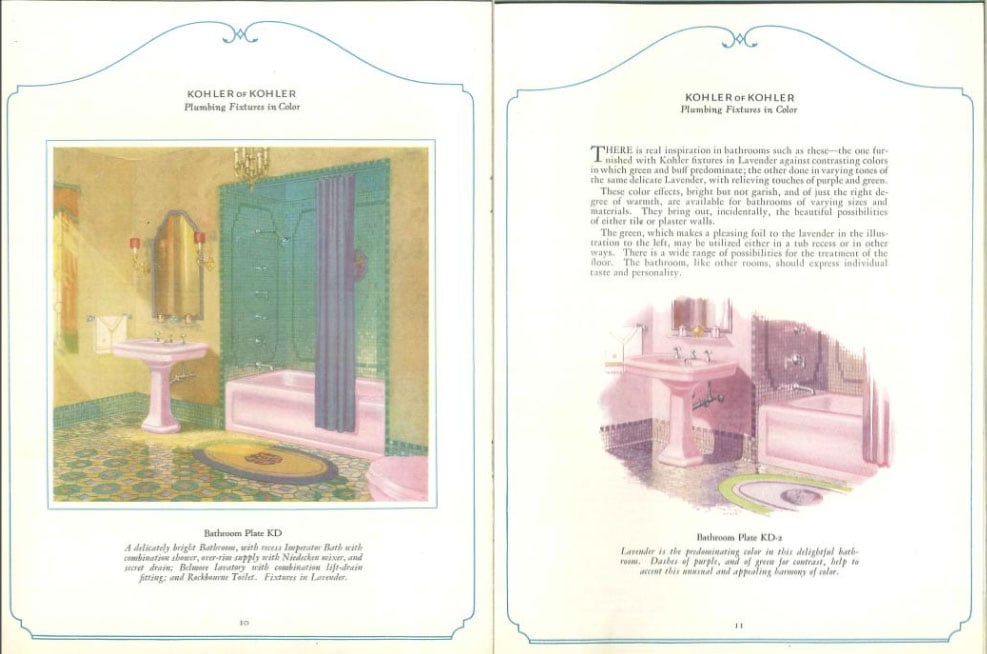
1927: The Color Revolution
For decades, bathroom fixtures came in only one flavor: white. Not because America lacked imagination, but because matching enamel color across multiple materials was nearly impossible.
Until Kohler changed the rules.
In 1927, the company launched a coordinated suite of fixtures—sinks, tubs, toilets—in six harmonious colors: Horizon Blue, Old Ivory, Spring Green, Lavender, Autumn Brown, and West Point Gray.
This wasn’t just innovation. It was design leadership.
As Alyssa Wilterdink, Kohler’s senior manager of brand partnerships, puts it:
“Delivering matching color across an entire bathroom—that was something only Kohler could achieve at the time.”
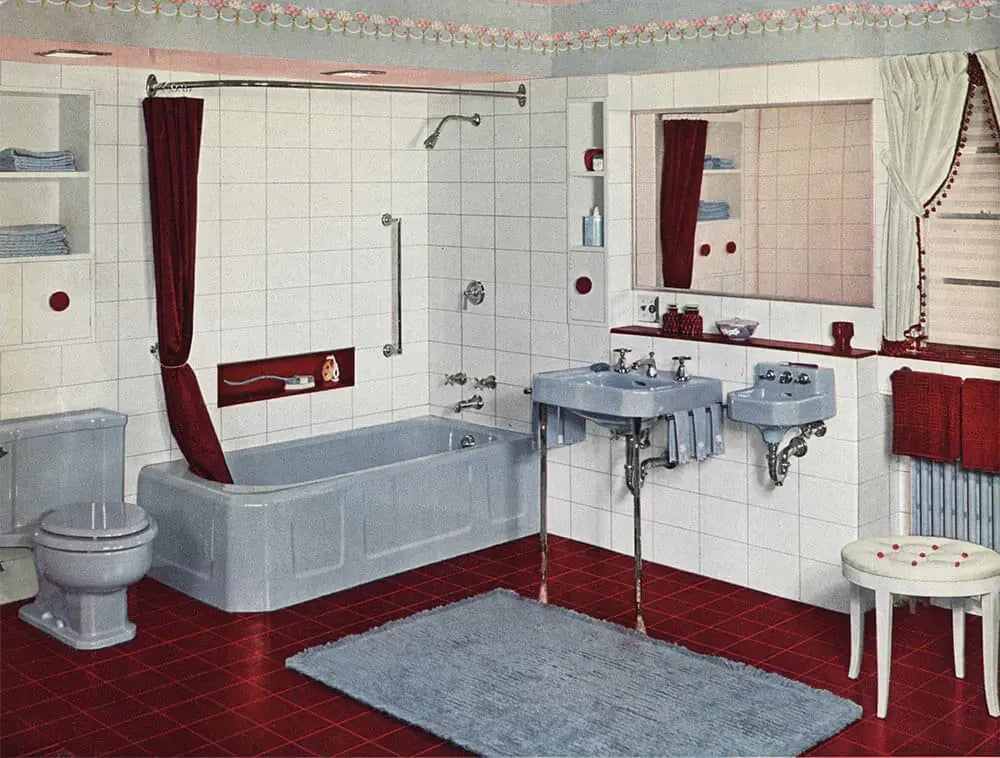
They didn’t stop at color. Kohler released full bathroom design guides in Italian, English, Modern, and French; complete with tile pairings. And through the decades, they continued to push bold palettes: Peachblow in the ’30s, Sunrise in the ’50s, saturated hues in the ’60s and ’70s, and of course, legendary Avocado.
In 2023, celebrating its 150 year anniversary, Kohler resurrected two vintage colors—Spring Green and Peachblow—after over 100,000 online votes.
Design nostalgia meets modern engineering. Perfect.
Innovation Through the Decades
As we zoom out from Kohler’s early trials and triumphs, it helps to fast-forward a bit—to look not just at the company that survived fires, loss, and reinvention, but at the century of milestones that followed. Because Kohler didn’t simply adapt to the shifting needs of American homes; it helped define them.
Across decades of economic upheaval, cultural change, and technological leaps, Kohler kept doing what it had done from the very beginning: innovating in ways that quietly reshaped daily life. And when you trace the arc of its history, from the Great Depression to the rise of mid-century luxury to the modern push for water conservation, you start to see a pattern emerge: Kohler wasn’t reacting to history; it was helping make it.
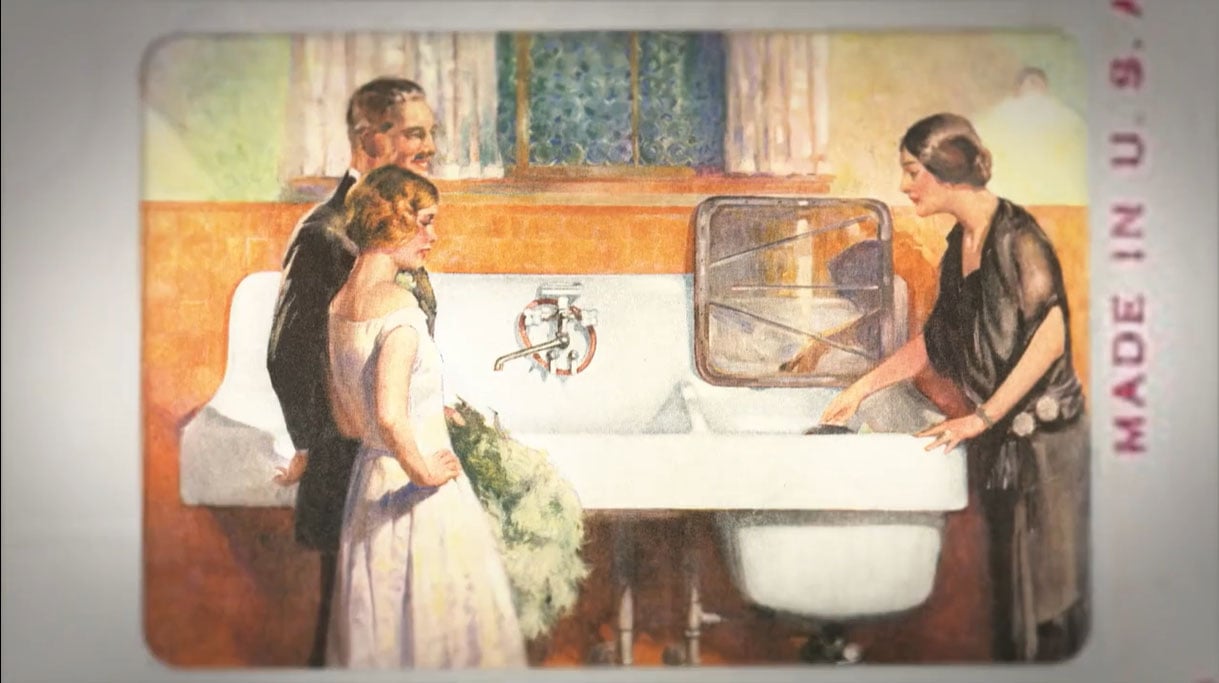
1930s–1940s: Weathering the Great Depression
When residential construction collapsed by nearly 90%, Kohler didn’t shut down. They kept workers employed, produced inventory, and diversified into generators—products so reliable that Admiral Richard Byrd used them on his Antarctic expeditions. When Byrd returned in 1933, the original generators were still running in the frozen wilderness.
That’s the kind of reliability you brag about.
1950s–1970s: The Whirlpool Era
As postwar America embraced comfort, leisure, and the idea of the home as a personal retreat, Kohler helped redefine what bathing could be. During the mid-20th century, Kohler built on hydrotherapy innovations pioneered by the Jacuzzi family, integrating powerful, adjustable jets into built-in whirlpool tubs that brought spa-like relief into everyday homes.
These weren’t novelty features. Kohler’s engineering focused on circulation, ergonomics, and control, allowing homeowners to tailor water pressure and jet placement for relaxation, recovery, or therapeutic benefit. The bathroom began to shift from a purely functional space to one associated with restoration and well-being.
By the 1970s, the whirlpool tub had become a symbol of attainable luxury—proof that wellness didn’t require leaving home. Kohler wasn’t just responding to cultural change; it was quietly shaping it.
1990s–2000s: Water Conservation Leadership
As environmental awareness and regulation intensified in the late 20th century, the plumbing industry faced a reckoning. Early low-flow toilets, introduced to reduce water usage, often failed homeowners, clogging frequently and delivering inconsistent performance.
Kohler took a different approach. Instead of accepting compromise, they rebuilt the category from the inside out. Engineers rethought bowl geometry, trapway design, flushing dynamics, and pressure-assisted systems—proving that toilets could use significantly less water and work better than their predecessors.
This performance-first mindset positioned Kohler as a leader when the EPA launched the WaterSense program in 2006. Their products didn’t just meet the new standards; they helped define them. Today, Kohler offers more than 100 WaterSense-certified products across toilets, faucets, and fixtures.
Conservation, for Kohler, wasn’t a reaction to regulation. It was a continuation of a long-standing belief: innovation should solve real problems without asking homeowners to lower their expectations.
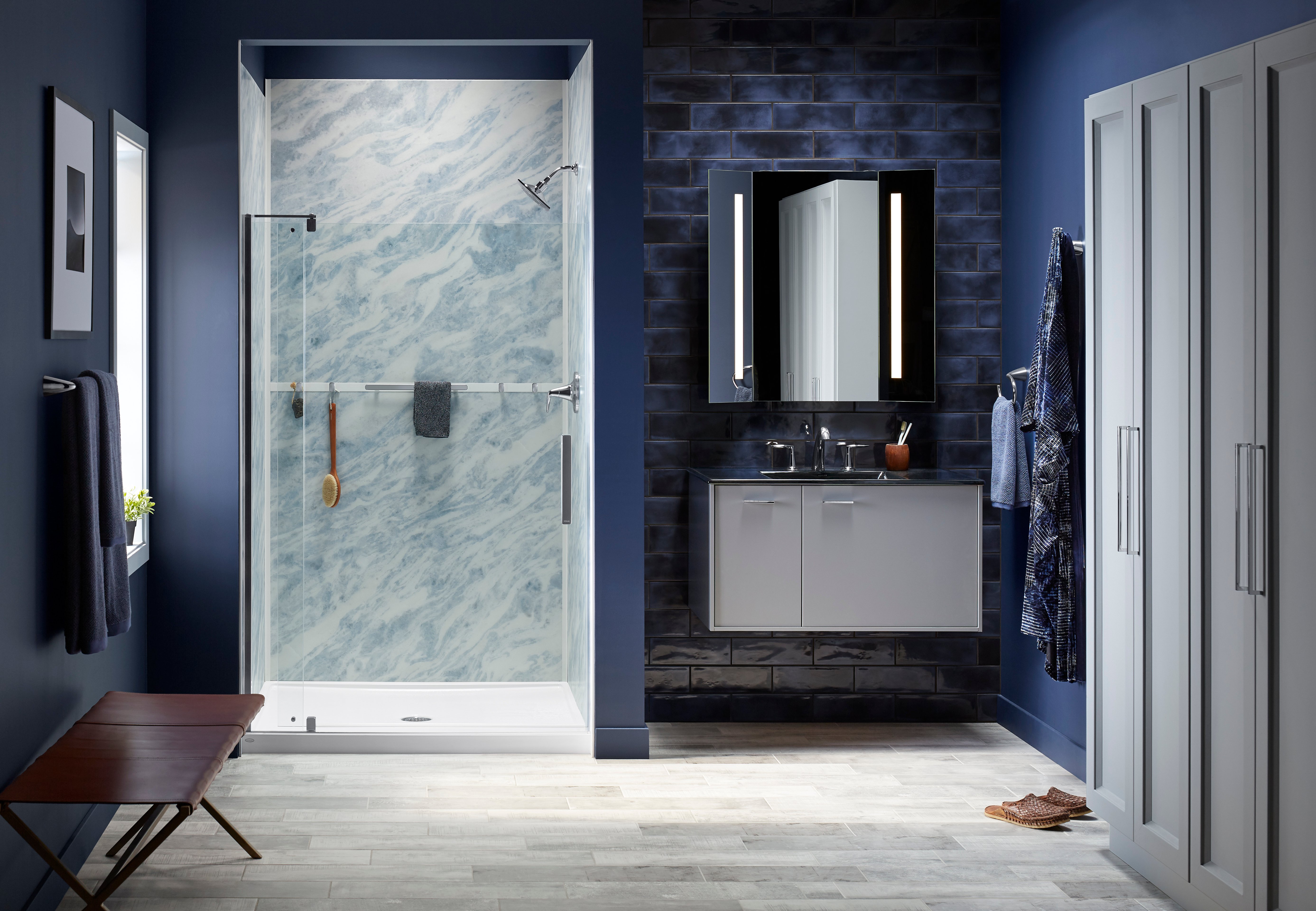
The Modern Era: LuxStone & Accessible Bathing
As we move into more recent history, and into the bathrooms we recognize today, the through-line becomes even clearer: Kohler’s innovation didn’t slow with time; it sharpened.
The company that once transformed a horse trough into a bathtub is now reshaping how we shower, age, and live well in our homes. In the past decade, Kohler’s focus has shifted toward smarter materials, easier maintenance, and solutions that meet real human needs—from the busy Denver homeowner who wants a beautiful shower without the upkeep, to the older adult in Colorado Springs who wants to age confidently in place. Which brings us to two of Kohler’s most influential modern breakthroughs: LuxStone showers and accessible walk-in baths.
LuxStone Showers
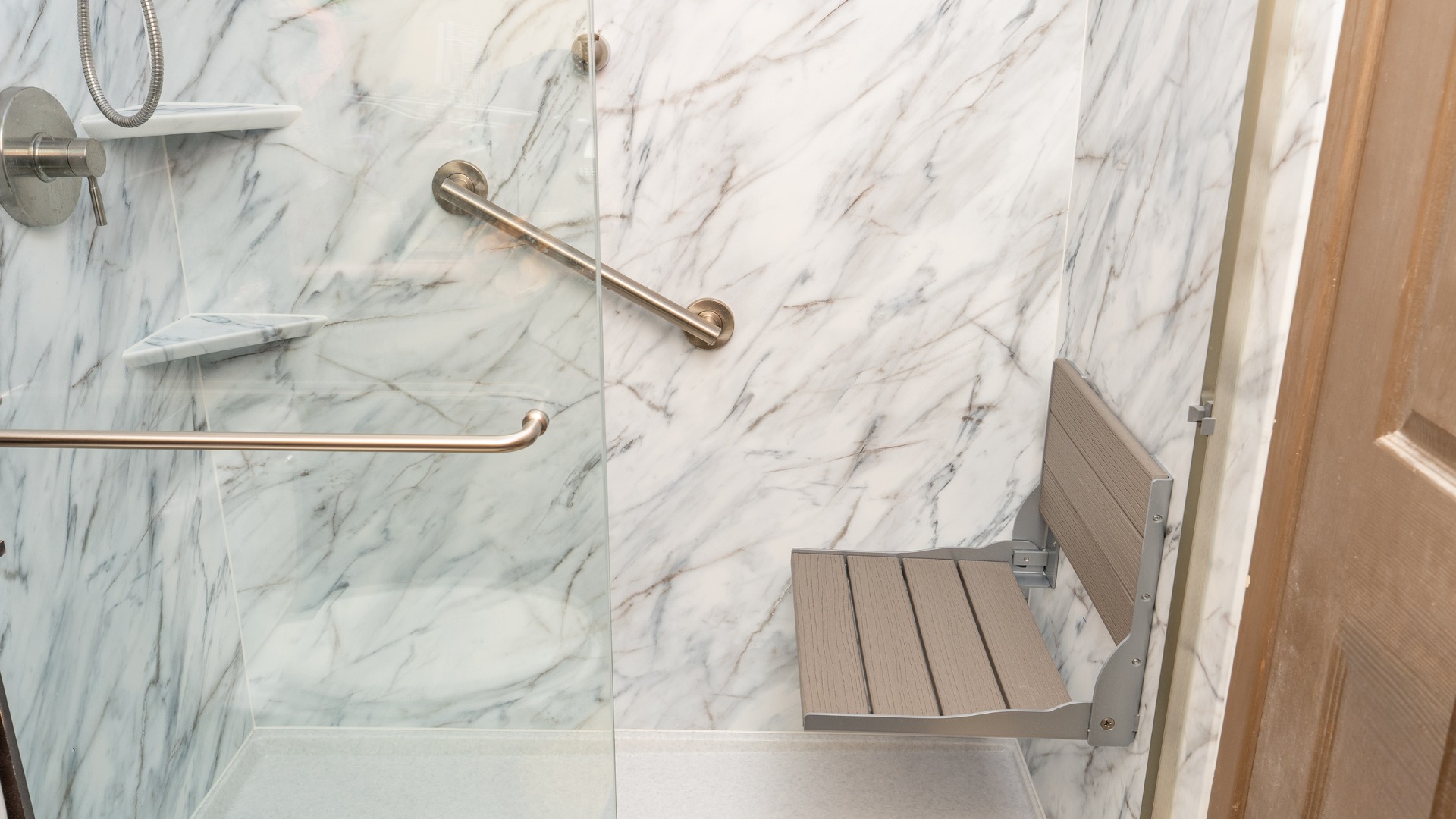
In the 2010s, Kohler introduced LuxStone,shower walls made from Serica, a composite of 70% crushed stone. They look like marble or natural stone, but outperform both. Especially for Colorado homeowners who live with seasonality and constantly changing climates, temperatures, and hard water. Here’s 5 ways LuxStone outperforms any other shower surface (tile, fiberglass, natural stone, acrylic):
1. Non-porous surface = minerals can’t “stick”
LuxStone’s composite of crushed stone and resin is completely non-porous, which means:
- Hard water minerals can’t penetrate
- Stains don’t set
- There’s nothing for calcium or lime to “grip” onto
This is a major contrast to tile grout or natural stone, which have microscopic pores that trap mineral deposits.
2. No grout lines = no buildup zones
Hard water loves to collect in porous, uneven surfaces—especially grout. LuxStone is a solid surface which eliminates grout entirely.
No grout =
- No chronic discoloration
- No chalky residue that builds in seams
- No scrubbing with harsh descalers
Just smooth, continuous panels.
3. Easier cleaning (and fewer harsh cleaners needed)
Because minerals don’t bond tightly to the surface, cleaning is basically:
- A soft cloth
- Mild cleaner
- A quick wipe-down
No acidic cleaners. No wire brushes. No kneeling with a toothbrush to rescue stained grout. This not only preserves appearance, it also preserves the life of the shower, because harsh chemicals degrade tile, stone, and acrylic over time.
4. Resistant to etching and dulling
Natural stone (like marble or travertine) can etch when exposed to mineral-rich water. Acrylic can dull or yellow. Fiberglass can pit. LuxStone doesn’t do any of that. Its composite structure is engineered to resist:
- Etching
- Dulling
- Surface wear
- Chemical staining
Even after years of hard water exposure, it remains unchanged. Beautiful. Durable as Kohler himself.
5. Prevents mildew caused by mineral buildup
Hard water leaves behind tiny deposits that trap moisture—creating a breeding ground for mildew. LuxStone’s smooth, non-porous surface means:
- No buildup
- Faster drying
- Dramatically reduced mildew risk
This is a big lifestyle benefit for Colorado homeowners.
In short: Hard water can’t penetrate it, cling to it, stain it, or wear it down. LuxStone keeps its smooth, like-new appearance without the weekly scrubbing war. That’s the product of the 152-years of innovation we’ve been reading about.
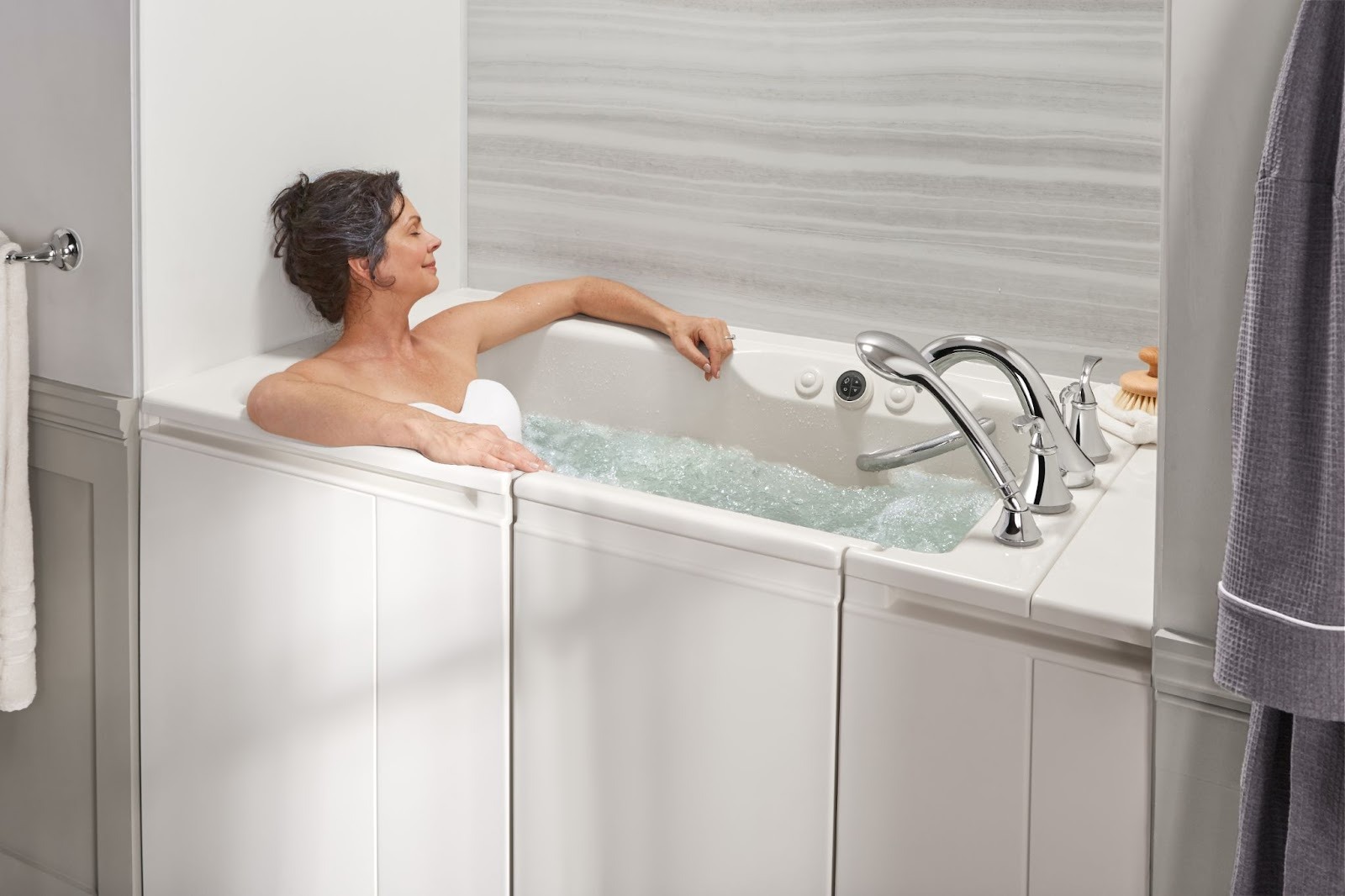
Walk-In Baths
In 2015, Kohler created an entire division dedicated to accessibility. Not as an afterthought, but as a fundamental design priority driven by a clear need. As America’s population aged and more homeowners sought safe, dignified ways to remain in their homes, Kohler recognized that traditional bathtubs and retrofitted add-ons weren’t enough.
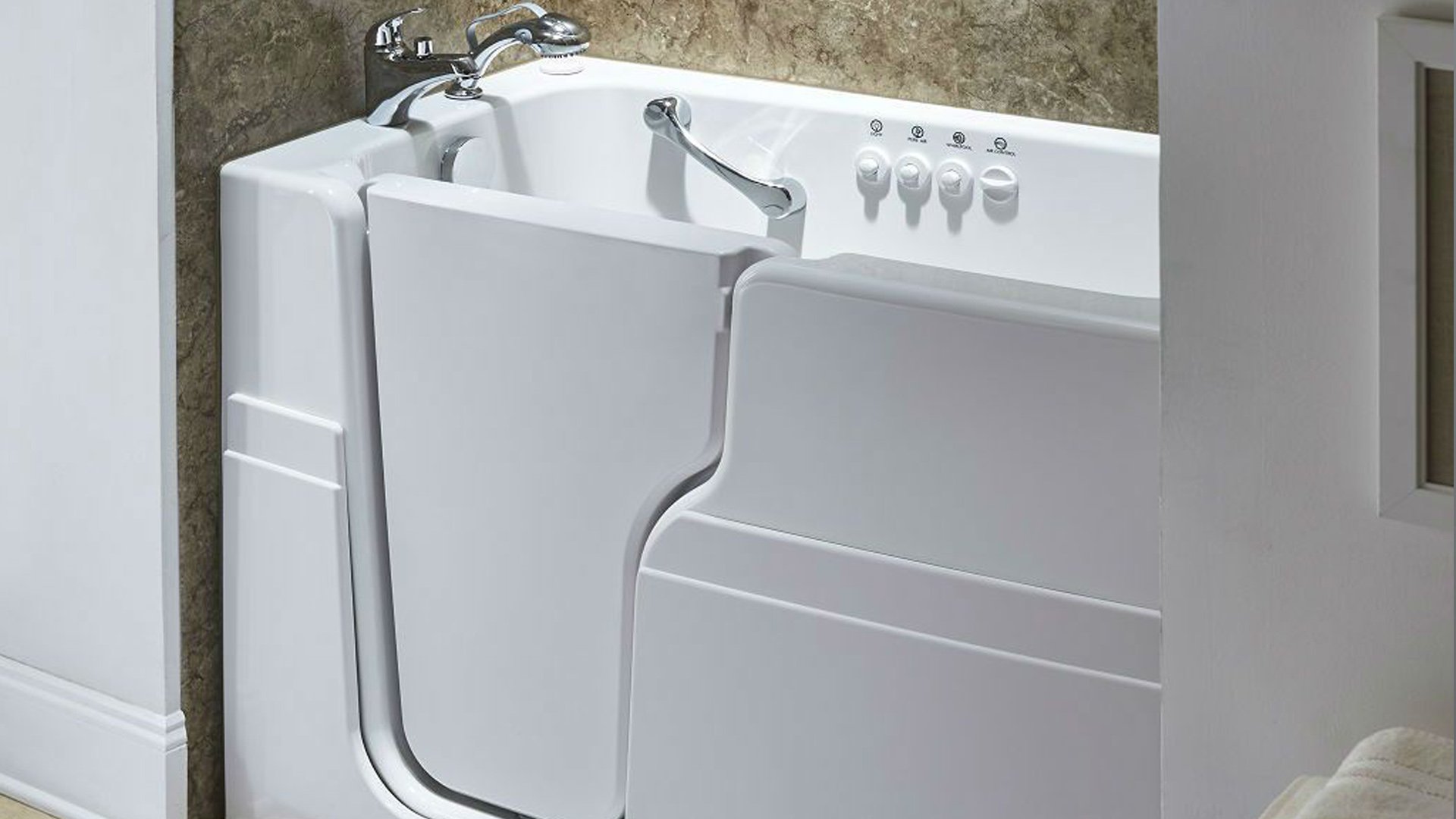
They set out to engineer a bathing experience that combined safety, comfort, therapy, and beauty in one thoughtful system, leading to the modern walk-in bath.
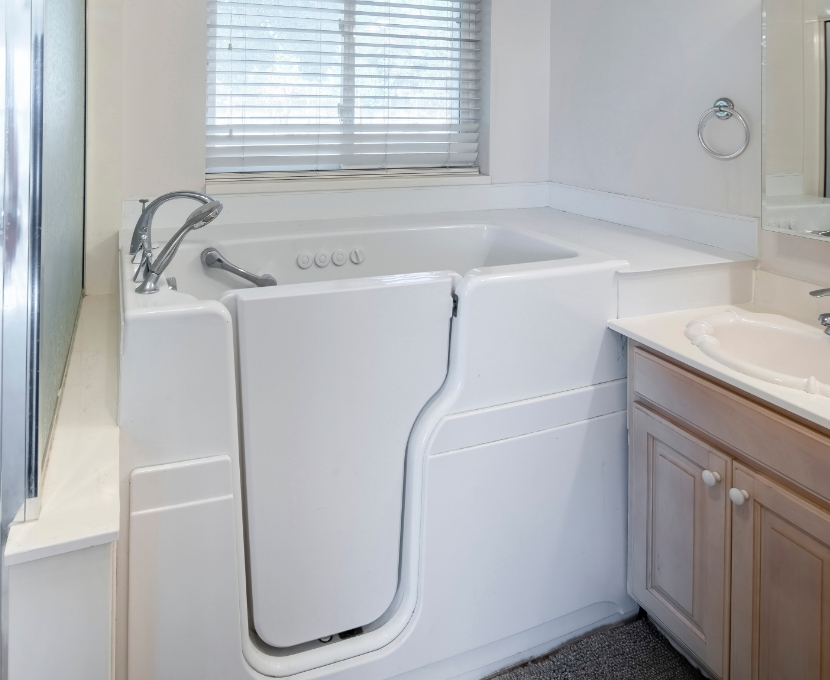
Features of Kohler’s industry standard walk-in baths include:
- 3-inch step-in threshold (one of the lowest available)
- Wide, watertight door
- Handrails and grab bars
- Hydrotherapy jets
- BubbleMassage
- Heated backrest
- Fast fill and fast drain
- Lifetime limited warranty
With Colorado’s aging population growing rapidly, this isn’t just innovation. It’s freedom.
What 153 Years of Excellence Means for Your Remodel Today
So why the history lesson? Why did we take you on this journey and cover 153 years of what was? Because you’re choosing the materials and products that will live in your home now, and for the next 20, 30, even 50 years. And perhaps, knowing the history behind those products, the quality, innovation, resilience, and commitment to homeowners—perhaps you will walk away for a better understanding of Kohler, and why it stands apart as a world-class product line.
You’re not just buying a shower or a bathtub. The real thing you’re betting on is the company behind it. Kohler’s 153-year story isn’t trivia. It’s a track record. A promise. A century-and-a-half of proof that the things we use every day should be built with intention, innovation, and an eye toward the long haul. The same spirit that transformed a farm trough into a bathtub is the spirit behind the products we install in Colorado homes today.
- Products That Last
Kohler fixtures from the 1950s, ’60s, and ’70s are still operating in homes across America today. That kind of longevity doesn’t happen by accident; it happens because the company has always built products to outlive trends, fads, and even a few homeowners. And when you’re investing $14,000–$40,000 in a bathroom remodel, that’s not a detail. It’s the whole point. You want something that won’t need replacing in five years. Kohler delivers that.
- Innovation You Can Feel
From a cast-iron horse trough turned into a bathtub to fully engineered walk-in baths and grout-free LuxStone showers, Kohler has never stopped evolving. And they don’t innovate for showrooms. They innovate for real life.
For messy kids.
For aging parents.
For hard water.
For busy schedules.
For homeowners who want beauty and practicality in the same package.
- American Craftsmanship
In an era when many manufacturers chase cheaper overseas production, Kohler continues to design and manufacture many of its flagship products, especially its walk-in baths, right in Wisconsin, where the company was born. That means tighter quality control, more consistent materials, and a level of pride you can actually feel in the finished product. - Industry-Leading Warranties
A company doesn’t offer lifetime limited warranties lightly. Kohler can do it because they have 153 years of engineering behind them and generations of products that have stood the test of time. This isn’t marketing—it’s muscle memory. When Kohler backs something, they mean it. - Built for Colorado Conditions
Colorado has its own set of challenges: mineral-heavy hard water, dry air, and elevations that push plumbing systems harder than most states. Kohler’s non-porous LuxStone surfaces resist mineral buildup like nothing else. Their WaterSense toilets help conserve water in our semi-arid climate. Their walk-in baths are engineered to perform, fill, and drain reliably even in high-elevation homes. These products weren’t just designed to survive in Colorado—they’re built to excel here.

HomePride: Colorado’s Kohler Experts
As a Reveal by KOHLER Authorized Dealer, HomePride Bath doesn’t just install products. We champion a legacy. We choose to work with Kohler because we believe homeowners deserve solutions that don’t just look good today but still perform beautifully 10, 20, even 40 years down the road.
And yes, that means we’re not the cheapest option in the market. That’s intentional. Because cutting corners may win bids, but it doesn’t win trust. We’d rather provide products and craftsmanship that stand out from the average, and stand up to Colorado living with real quality, value, innovation, and durability.
Homeowners trust us because we hold ourselves to the same standard Kohler set more than a century ago: do it right, do it well, and do it to last. We know price matters. But so does waking up every day to a bathroom that still looks and performs like the day it was installed
- Reveal by Kohler Authorized Dealer who understands every detail of the systems we install
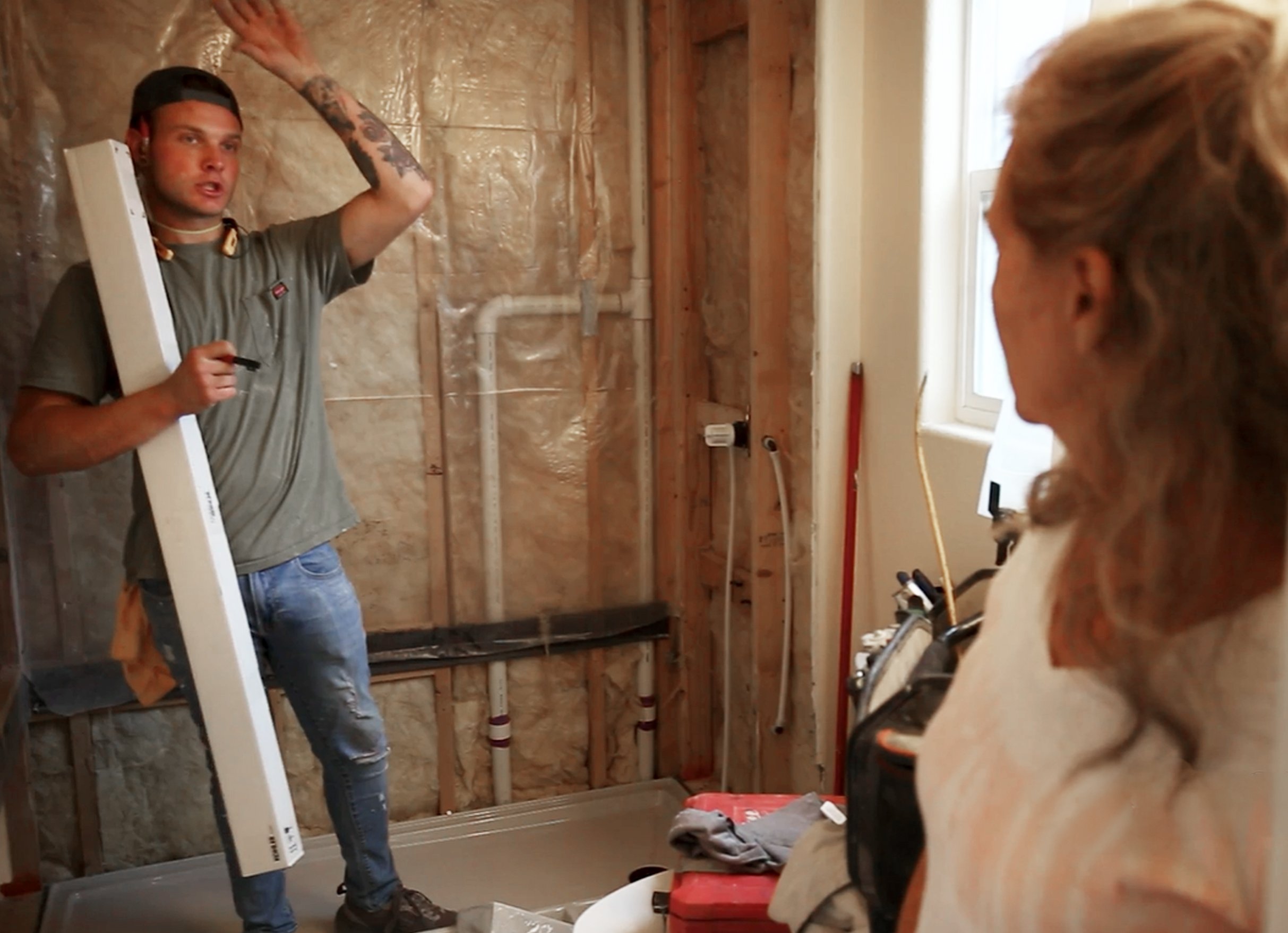
- Factory-Trained installers trained to meet factory specifications—not approximations
- Deep knowledge of how Kohler products perform in Colorado’s unique climate
- Full warranty support and access to genuine Kohler parts for long-term peace of mind
- A Live With Grace philosophy that means we educate first, recommend second, and sell only when it genuinely serves the homeowner
When you choose Kohler through HomePride, you’re choosing craftsmanship rooted in 152 years of innovation and reinforced by local experts who take your project—and your investment—seriously.
You’re choosing reliability over shortcuts, transparency over pressure, and a team that stands behind every product and every installation as if it were going into our own homes. We’ll walk you through every option, every price, and every pro-and-con—no pressure, ever.
Because your bathroom shouldn’t just be remodeled. It should be remarkable.
Want to explore Kohler products for your Colorado home? Visit our website to schedule your free consultation or a callback when it’s most convenient for you.
We’d be honored to help you create a bathroom that feels timeless, thoughtful, and beautifully… you. Where you become part of the Kohler legacy.
Frequently Asked Questions about Kohler
1. Is Kohler really worth the price compared to cheaper bathroom products?
Yes, if you want a bathroom that lasts. Cheaper acrylic or big-box materials may look good on day one, but they often discolor, crack, or fail within a few years. Especially in Colorado’s mineral-heavy water. Kohler’s 152-year engineering track record, lifetime warranties, and premium materials (like LuxStone) are specifically built to outperform the inexpensive alternatives over decades, not months.
If you’re investing $14,000–$40,000 in a remodel, durability is not a luxury—it’s the priority.
2. How does KOHLER hold up against Colorado’s hard water and climate?
Exceptionally well. Unlike tile or natural stone that can absorb minerals and stain, Kohler’s LuxStone shower walls are non-porous, grout-free, and engineered to resist hard water buildup. Their walk-in baths and plumbing systems are tested and proven to perform reliably in higher elevations, meaning fewer headaches with pressure, flow, and long-term maintenance.
For Colorado homeowners, this is one of Kohler’s biggest advantages.
3. How do I know if a KOHLER factory-trained installer actually matters?
KOHLER factory-trained installers are trained to follow exact factory specifications, not “close enough.” This directly affects:
-
Water tightness
-
Structural stability
-
Warranty coverage
-
Long-term durability
Choosing an installer like HomePride ensures your products perform exactly as engineered, and you maintain access to full warranty support. In other words: the right installer protects your investment just as much as the product you choose.