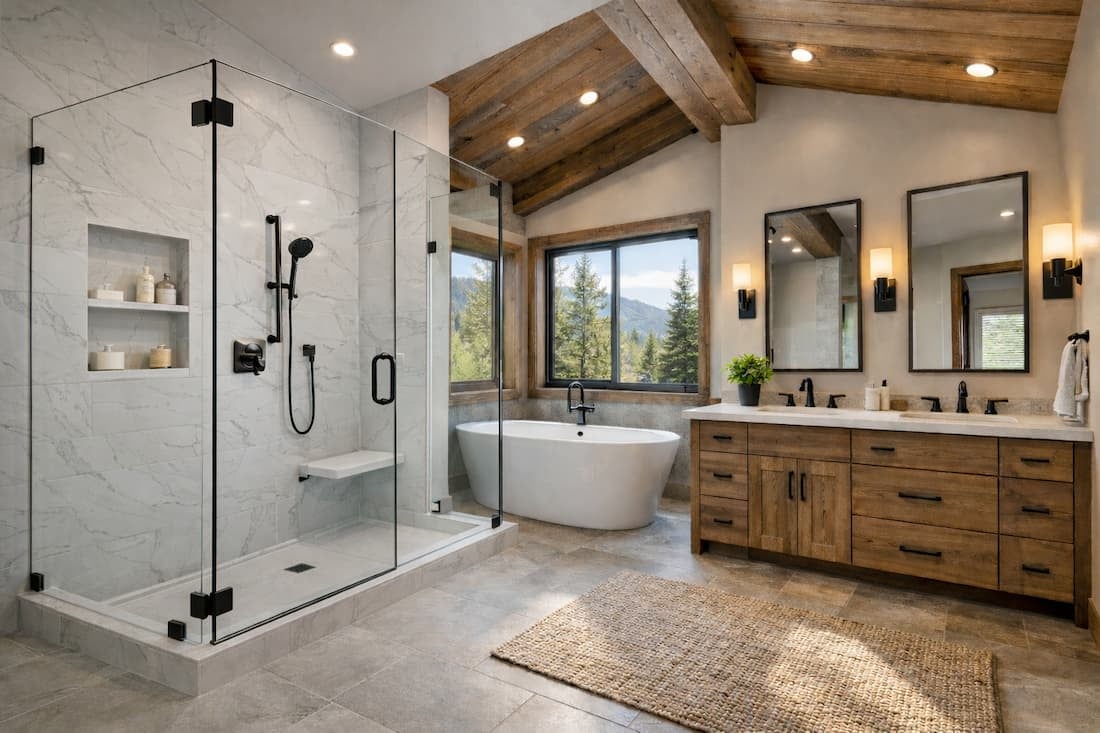

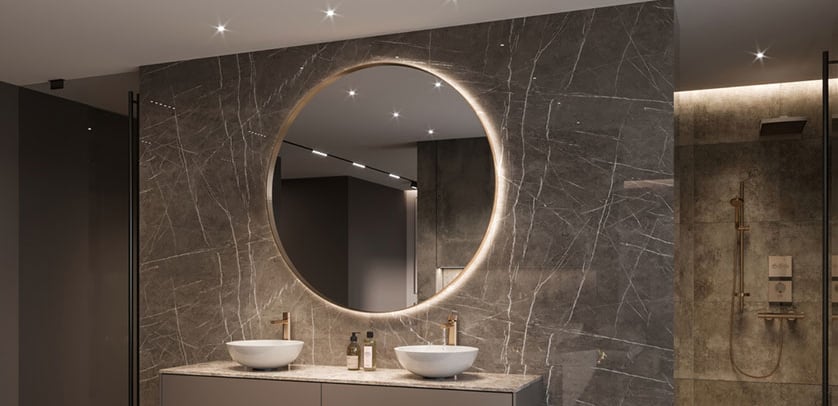
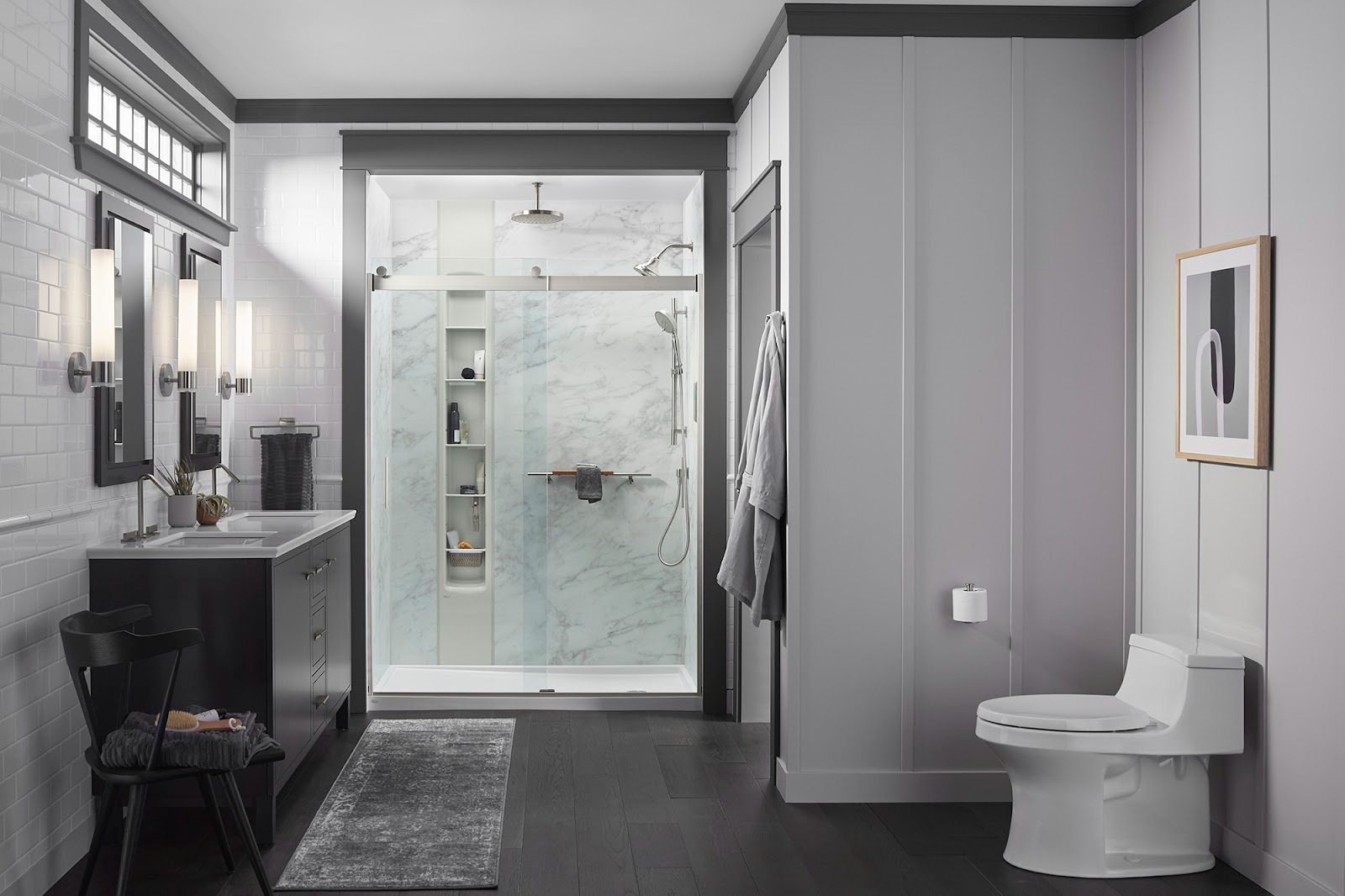
If you’re planning a bathroom remodel—or just trying to fix that dim, shadowy vanity mirror—you’ve probably realized lighting is a bigger deal than most people think. Great lighting isn’t just about making the room look pretty (though it helps).
It’s about safety, function, and creating a space where you actually want to start and end your day.
And in Colorado, where daylight hours shift dramatically with the seasons and elevation varies from Denver to Durango, your lighting needs to do more than just flick on. It needs to work for your space and your routine—no matter the time of day or time of year.
This article is written for Colorado homeowners planning a bathroom remodel who want lighting that’s safe, functional, and designed for the state’s unique climate. Our guide explains the best bathroom lighting for Colorado homes, including how to layer lights, choose the right bulbs, and avoid common lighting mistakes that impact safety and comfort.
Why Lighting Should Be a Top Priority in Your Bathroom Remodel
Let’s be honest—most of us don’t give lighting much thought until it’s too dim to shave or too harsh to apply makeup. But in a bathroom, the right lighting setup is critical for:
- Grooming and getting ready without weird shadows or eye strain
- Preventing slips and trips, especially around wet surfaces
- Creating a relaxing vibe for soaking in the tub or winding down at night
In a recent article, This Old House points out, “Good lighting can make your bathroom feel more spacious, highlight its best features, and even improve your daily routines.” That’s why professional designers (and smart Colorado homeowners) take a layered approach—combining ambient, task, and accent lighting to cover every need.
Picking the right lighting isn’t just about style—it’s about how well your bathroom works. As luxury bathroom fixture designer Badeloft explains, there are four things that matter most:
✅ Brightness – Make sure there’s enough light to safely move around and clearly see what you’re doing.
✅ Color Temperature – Stick to warmer tones (2700K–3000K) for a flattering, comfortable glow.
✅ Placement – Position your lights to minimize shadows—especially around mirrors and in the shower.
✅ Efficiency – Opt for LED fixtures to save on energy bills without sacrificing quality or design.
Now that you know what to consider when choosing bathroom lighting, let’s break down the three main types—and why each one plays a key role in creating a safe, functional, and beautiful space.
What Is the Best Bathroom Lighting Setup?
The best bathroom lighting setup uses layered lighting—a combination of ambient lighting for overall brightness, task lighting for grooming and precision work, and accent lighting to add depth and visual interest.
This approach reduces shadows, improves safety, and creates a bathroom that functions well at any time of day or year, which is especially important in Colorado homes where daylight changes dramatically by season.
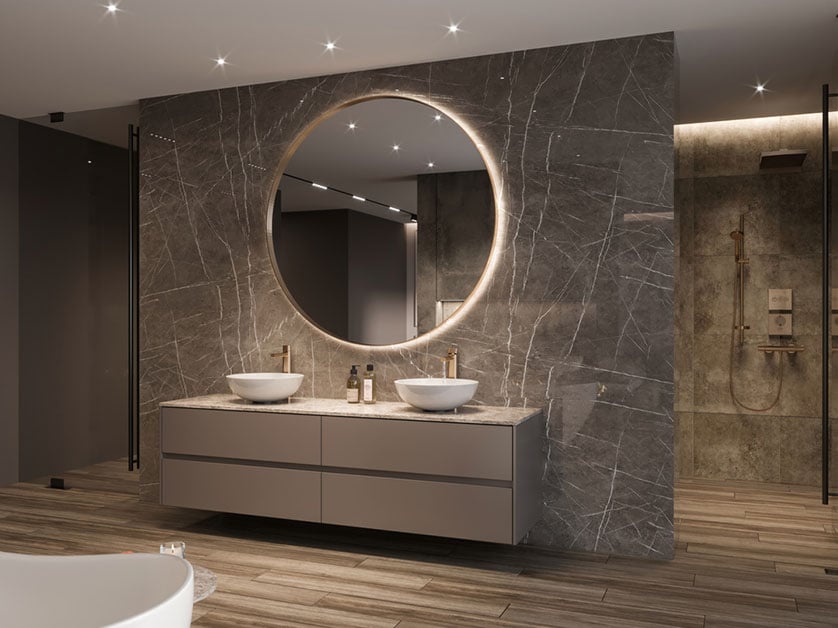
The Three Types of Bathroom Lighting (and Why You Need Them All)
Proper bathroom lighting is critical for grooming, safety, and creating a relaxing environment. Layered lighting—combining ambient, task, and accent sources—helps eliminate shadows, highlights design features, and supports activities like shaving or makeup application.
1. Ambient Lighting – The Foundation
This is your main source of light—the one that fills the whole room. This will make up the majority of the lighting in your bathroom. Many experts, including Modern Place Lighting recommend 20-50 footcandles which generate “a pleasant degree of light and exude serenity and roominess”.
Best options:
- Ceiling-mounted fixtures (flush mounts, semi-flush)
- LED can lights or cove lighting
- Natural light from windows or skylights (huge bonus in Colorado!)
Pro Tip for Colorado Homes: Even if you have great natural light, cloudy days and long winter nights mean you’ll still want reliable overhead fixtures to keep your bathroom bright year-round.
🔎 Learn more about how light is measured (footcandles/lumens) here
2. Task Lighting – Where Function Meets Precision
This is the lighting that really counts—especially around your vanity and or mirror. Think of task lighting as your “precision lighting ” that targets and focuses on specific areas. As Designer Premiere points out, task lighting should be three times as bright as ambient lighting to work most effectively.
Best options:
- Vertical sconces or light bars on either side of the mirror (36–40" apart and at eye level)
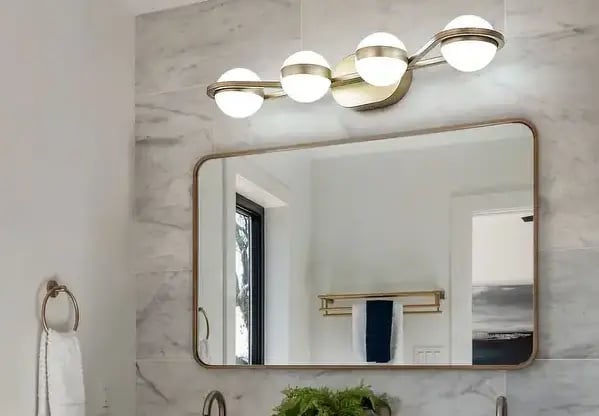
- Over-mirror lighting at least 24" wide and mounted 75–80" high
Why it matters: You don’t want shadows under your eyes or chin when you’re getting ready. Task lighting gives you that clean, even glow you need for shaving, makeup, or contact lenses.
As HGTV designer Candice Olson puts it,
“Strip makeup lights just don't give you a fighting chance no matter how good looking you are. Light sconces that flank the mirror illuminate your entire face evenly.”
In other words, skip the old-school Hollywood strip bulbs and go with vertical sconces placed 36–40 inches apart at eye level. You’ll get much better light—and a much better look in the mirror.
3. Accent Lighting – Add a Little “Wow”
Accent lighting is the unsung hero of great bathroom design—the layer that takes your space from simply functional to truly spa-like. While ambient and task lighting cover the basics, accent lighting adds depth, character, and that designer touch that makes the whole room feel thoughtfully finished, not just well-lit.
As Jaguar explains, “Accent lighting is a technique used to emphasize certain elements within a room. Unlike general lighting, which provides overall illumination, accent lighting is focused on drawing attention to specific features or areas.” Accent lighting isn’t required—but it can completely transform your space.
Ideas to try:
- Recessed spotlights on tile walls or art
- LED strip lights under floating vanities or behind mirrors
- Backlit niches in showers or above tubs for a spa feel
Accent lighting adds depth, visual interest, and a touch of luxury—especially in smaller Colorado bathrooms that need a little extra personality.
How Do You Light a Small Bathroom Properly?
To properly light a small bathroom, focus on vertical task lighting at the mirror, even ambient lighting across the ceiling, and minimal accent lighting to avoid visual clutter. Avoid relying on a single overhead fixture, which can create harsh shadows and make small spaces feel cramped.
How to Layer Your Lights Like a Designer
The best-lit bathrooms don’t rely on just one type of light. You need a mix. As California designer Anne Sneed explains:
“Sometimes people think a sconce alone will be romantic, and it just doesn't work. You want a few different sources of bathroom lighting to make the room pretty but also functional.” (Miranda Silva, 2021)
That’s why our pros in Colorado use a layered lighting approach: ambient lighting for overall brightness, task lighting for grooming, and accent lighting for style and personality.
-
Ambient first. Start with overhead lights or natural light.
-
Task next. Make sure your vanity and mirror are evenly lit.
-
Accent last. Add the extras that bring personality and calm.
Bathroom Lighting at a Glance
✅ Best overall lighting approach: Layered lighting using ambient, task, and accent lighting
✅ Best bulb type: LED
✅ Ideal color temperature: 2700K–3000K
✅ Best vanity lighting: Vertical sconces at eye level, spaced 36–40 inches apart
✅ Best safety rating: Damp- or wet-rated fixtures
✅ Best upgrade: Dimmer switches for flexibility and comfort
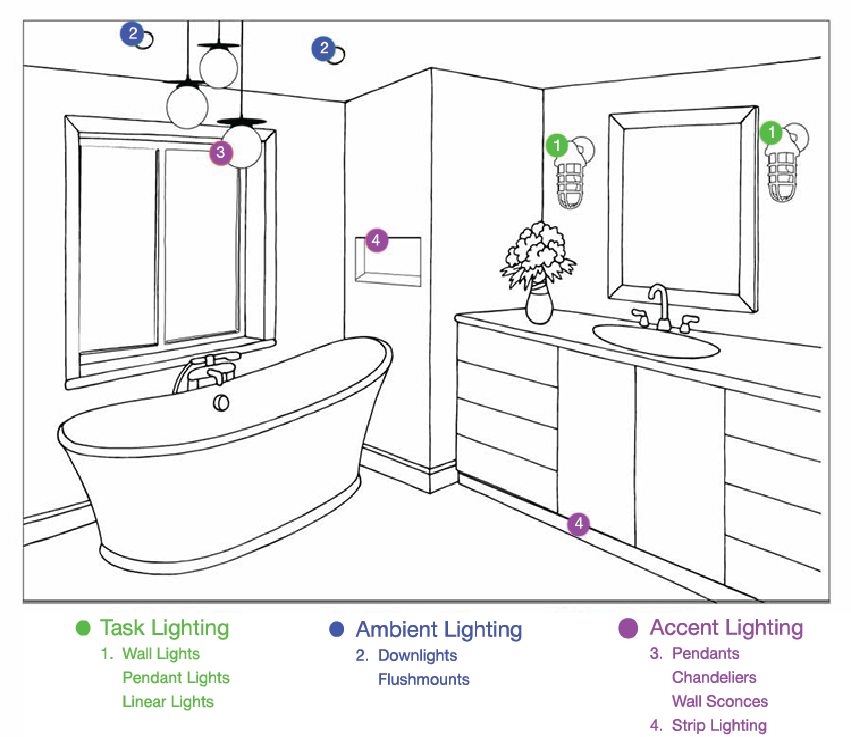
Bathroom Lighting Diagram
(courtesy of Fat Shack Vintage)
One small upgrade that makes a big impact? Dimmer switches. They let you shift from energizing morning routines to calm evening soaks—all with the same fixtures.
Designer Jonathan Adler even jokes,
“Bathrooms deserve moody lighting and, bonus, four out of five people agree your wrinkles will look less wrinkly in diffused light.” (Megan Slack, 2022)
Translation? Dimmers aren’t just about setting the mood—they help everyone look and feel their best. Win-win.
- Add dimmers to everything (yes, even the shower!)
- Use smart controls or motion sensors to save energy and avoid fumbling for switches at night
What Kind of Bulbs Work Best in Colorado?
Like any other bathroom fixture, there are several types and options homeowners can choose from. Based on our experience designing and remodeling over 2,000 bathrooms across Colorado—from Denver condos to mountain homes—we’ve seen firsthand how high altitude, dry air, and seasonal daylight shifts affect lighting performance, bulb longevity, and overall comfort.
- LEDs are king. They’re energy-efficient, long-lasting, cool to the touch (important at altitude), and available in every color temperature.
- Select bulbs with a color temperature of 2700K–3000K for a warm, flattering glow.
- Look for a CRI over 90 (Color Rendering Index) if you want true-to-life color for tasks like makeup.
- Only use damp- or wet-rated bulbs and fixtures in bathrooms to prevent damage or discoloration.
🏔️ Colorado Climate Tip: Lighting that works where you live.
Because of Colorado’s high altitude and dry air, traditional incandescent bulbs can overheat and wear out faster than expected. We recommend LED fixtures not just for energy efficiency, but because they run cooler—making them a safer, longer-lasting choice for mountain homes.
Also, with Colorado’s wide seasonal swings in daylight, dimmers and layered lighting are essential for comfort—from bright mornings in winter to soft, calming evenings in summer.
Lighting the Shower and Tub (Without Worrying About Water)
For showers and tubs, safety and moisture resistance are non-negotiable. Here’s what to use:
- Wet-rated recessed LED lights with sealed glass lenses
- Waterproof LED strip lights for alcoves, niches, or base lighting
- No open-bulb fixtures—even if they “look” sealed, they’re often not rated for steamy areas
And always check the product specs: If it doesn’t say “wet-rated,” it doesn’t belong near your water features.
✅ Safety & Efficiency Must-Haves
Don’t overlook these essentials when planning your bathroom lighting:
⚡ Install GFCI Outlets
Required by code—place them near all water sources to prevent electrical shock.
💧 Use Damp- or Wet-Rated Fixtures
Only install moisture-rated lights within six feet of a shower or tub to stay safe and compliant.
🌟 Choose ENERGY STAR Fixtures
They’re more efficient, longer-lasting, and can lower your electric bill.
💸 Claim Colorado Energy Rebates
Many homeowners qualify for cash-back incentives through Xcel Energy and other local providers. Be sure to check!
Bathroom Lighting Requirements in Colorado Homes
While bathroom lighting codes are generally based on national electrical standards, Colorado homes must account for moisture control, altitude-related heat buildup, and energy-efficiency requirements.
Any lighting installed near showers or tubs must be damp- or wet-rated, GFCI protection is required near water sources, and ENERGY STAR-rated LED fixtures are strongly recommended for both safety and long-term efficiency.
Where to Shop for Bathroom Lighting in Colorado
Now that you are armed with all this lighting know-how, you may be wondering about next steps, and the best places to go to explore these wonderful new lighting ideas. You don’t have to go it alone—or settle for a box-store aisle. Here are some of the best local vendors our clients love:
- Urban Lights (Denver & Colorado Springs) – Massive selection and expert help
- Denver LED Direct – Great for energy-efficient upgrades and rebate guidance
- Galleria Lighting (Greenwood Village) – Designer picks and personalized service
- Fusion Light and Design – For custom or luxury projects across the Front Range
- Home Lighting (Colorado Springs) – ALA-certified staff and 160+ brands
- Lamps Plus (Denver) – A mix of budget-friendly and high-end options
Want Designer-Approved Fixtures?
Look for styles from Visual Comfort, Hudson Valley Lighting, Shades of Light, Barn Light Electric, and Kathy Kuo Home—all known for beautiful, functional pieces rated for bathroom use.
⚠️ Common Mistakes We See (So You Don’t Make Them)
Even the most beautiful bathroom can fall flat with poor lighting choices. Here are a few missteps we see again and again—easy to avoid if you know what to watch for:
- Relying only on a central ceiling fixture
- Skipping task lighting at the mirror
- Using the wrong color temperature bulbs (avoid harsh daylight LEDs!)
- Forgetting to install dimmers
- Choosing non-rated fixtures near water

Final Tip: When in Doubt, Call a Pro
We hope this article has given you a better understanding of bathroom lighting, and all the simple things you can do to make your bathroom more functional and beautiful.
If you're not sure how to wire, mount, or space your fixtures—or if you want to make sure you're up to code in Colorado—don’t DIY it. Call a licensed local electrician or contractor who understands both safety and style.
Need a hand planning your bathroom remodel—including lighting that’s safe, stylish, and built for Colorado living?
Our licensed Colorado-based installers bring years of hands-on experience in everything from electrical work to fixture placement. We’ve helped over 2,000 Colorado homeowners reimagine their bathrooms—from fixtures to lighting, to transform their bathrooms into next level experiences. Whether you’re looking for expert guidance or just need honest, no-pressure advice, the HomePride Bath team is here to help you design a space that’s functional, beautiful, and built to last—down to the very last lightbulb.
Frequently Asked Questions
1. What type of lighting is best for a bathroom in Colorado?
LED lighting is the best choice. It’s energy-efficient, runs cooler at high altitudes, and offers a range of color temperatures to match both functional and relaxing needs.
2. How bright should bathroom lighting be?
For ambient lighting, aim for 20–50 footcandles (depending on room size). Vanity task lighting should be 3x brighter to clearly illuminate your face without harsh shadows.
3. Can I use regular light fixtures near my shower or tub?
Not safely. Always use wet-rated fixtures within six feet of any water source. This is especially important in Colorado’s dry air, which can make overheating more likely with the wrong fixtures.
4. What’s the ideal color temperature for bathroom lighting?
Stick to 2700K–3000K for a warm, flattering glow. Avoid cooler daylight bulbs unless you're lighting a garage or workspace—harsh light can make bathrooms feel sterile and uninviting.
5. How can I make my bathroom lighting more energy efficient?
Choose ENERGY STAR-rated LED fixtures, install dimmers or smart controls, and check with your Colorado utility provider (like Xcel Energy) to see if you qualify for lighting upgrade rebates.
6. Where should bathroom lights be placed around a mirror?
For best results, install vertical sconces on either side of the mirror at eye level, spaced 36–40 inches apart. This provides even facial lighting and minimizes shadows better than overhead fixtures alone.
7. Are dimmer switches safe to use in bathrooms?
Yes, dimmer switches are safe when paired with moisture-rated fixtures and installed according to code. They are especially useful in Colorado homes where lighting needs change with seasonal daylight.
8. What bathroom lighting mistakes do professionals see most often?
The most common mistakes include relying on a single ceiling light, skipping vanity task lighting, using bulbs that are too cool in color temperature, and installing non-rated fixtures near water sources.
Topics: